Title
“You Just Need to Have the Imagination for It”: Maria and Ryszard Waśko’s “Vernissage” as a Pretext for Tactile Intervention in Art History
https://doi.org/10.48285/ASPWAW29564158.MCE.2025.11.1en
Maria Waśko, Ryszard Waśko, accessibility of art, hapticity, documentary films, Polish People’s Republic, tactile perception, disability studies
https://miejsce.asp.waw.pl/en/to-po-prostu-trzeba-miec-wyobraznie-do-tego/
Abstract
The basis for this article is the film “Wernisaż” [Vernissage] (1981) by Maria Waśko (screenplay with Ryszard Waśko), made from material recorded in 1979 during an exhibition of contemporary art for blind children at the Zapiecek gallery in Warsaw. In the analysis presented here, I argue that this film radically subverts the occularcentric order in favor of presenting tactile perception. Blind children are given the right to speak, which I attribute social and political significance to, reorganizing political sensory divisions in the direction of broadening the community of art recipients. In the film “Wernisaż,” [Vernissage] I find a contribution to writing a potential history that brings reflection on the contemporary condition of art history. I ask a crucial question: how can openness to blind audiences influence the rethinking of the social role of art history? Will it be possible to abandon hypothetical reflections on the haptical/multisensory perception of art in exchange for real touch and social agency?
Keywords
Maria Waśko, Ryszard Waśko, accessibility of art, hapticity, documentary films, Polish People’s Republic, tactile perception, disability studies
DOI
“Politics, indeed, is not the exercise of, or struggle for, power. It is the configuration of a specific space, the framing of a particular sphere of experience, of objects posited as common and as pertaining to a common decision, of subjects recognised as capable of designating these objects and putting forward arguments about them.”1
– Jacques Rancière
Introduction
I hereby request approval for the production of the screenplay by Maria Waśko and Ryszard Waśko entitled Vernissage. The recording of blind children’s first encounter with the world of art, their “viewing” of works of art and attempts at their interpretation will constitute the documentary value of the film. At the same time, it will create the conditions for a more reflective mode of reception, prompting consideration of the possibilities of art, its aesthetic and ethical functions, as well as the value and sources of abstract art.2
This request, dated 19 January 1980 and submitted by Teresa Oziemska – a longtime editor of films about art at the Educational Film Studio (WFO) in Łódź – was approved. The footage was recorded “as a matter of urgency,” even before receiving formal written consent, during an exhibition of contemporary art for children from the Educational Center for Blind Children in Laski, organized at the Zapiecek Gallery in Warsaw in 1979 on the initiative of Ryszard Winiarski.3 The works prepared by the invited artists – including Jan Berdyszak, Marian Bogusz, Anna Bohdziewicz, Jan Dobkowski, Stefan Gierowski, Jerzy Kałucki, Edward Krasiński, Adam Marczyński, and Henryk Stażewski – were subsequently donated to establish what was most likely one of the world’s first collections of contemporary art intended for blind audiences.4
The film Vernissage (Wernisaż) has remained virtually unacknowledged by both art historians and film historians.5 I discovered it several years ago while conducting research on Polish documentary films about art produced during the communist period,6 and I remembered it as a work whose significance becomes particularly legible from today’s perspective. I regard Vernissage as an important contribution to the formulation of a potential history of Polish art, and thus – following Ariella Azoulay’s definition – as a work that enables a “practice of unlearning” entrenched divisions that bar us “from engaging with others, a division that authorizes experts to determine with whom we are allowed to share the world and how, under which law.”7 As Azoulay further argues, “History is potentialized with the persistence, protection, transmission, and renewal of different ways of being in time and in the world that are still alive.”8
In Vernissage, I discern an opportunity to reconsider who is to be granted access to the so-called “visual” arts. More broadly, I approach the film as a contribution to the unlearning of visual-centric hegemony in favor of a communal experience in which diverse sensory models of art perception complement one another. In this framework, co-presence emerges in a socially differentiated space, expressed through the multiplicity of voices of all participants who occupy it. Enabling the articulation of voices belonging to blind and visually impaired individuals – traditionally excluded from the community of art recipients – constitutes a political and social act. As Aristotle observed, it is speech that defines the human being as a political subject, allowing for the expression of more than pleasure and pain.9 Jacques Rancière correctly links speech – and thus its political status – to the social configurations of sensibility that are central to my inquiry:
Politics consists in reconfiguring the distribution of the sensible which defines the common of a community, to introduce into it new subjects and objects, to render visible what had not been, and to make heard as speakers those who had been perceived as mere noisy animals.10
Following Rancière, I draw a clear distinction between the aesthetics of politics – closely aligned with the “aestheticization of politics” described by Walter Benjamin in relation to fascism – and the politics of aesthetics, which determines “the way in which the practices and forms of visibility of art themselves intervene in the distribution of the sensible and its reconfiguration, in which they distribute spaces and times, subjects and objects, the common and the singular.”11 Vernissage, which I analyze further in this article, introduces into broader circulation a model of art perception grounded in the reconfiguration of dominant visual centrism and expert authority in favor of disinterested cognition. Within this gesture, I identify the seeds of an opportunity not only to address questions of accessibility for people with visual impairments, but also to destabilize established modes of historical and art-historical discourse. In the Waśkos’ film, I perceive an impulse to rethink the social significance of art history itself – particularly in terms of radically expanding the community of its participants.
To Expand the Field of Art
The initiative to organize an exhibition of contemporary art for blind and visually impaired children was undertaken in connection with the International Year of the Child proclaimed by the United Nations. The Zapiecek Gallery, a branch of DESA directed by Mirosława Arens, joined the extensive program of public celebrations, which included the most spectacular series of events Artists of Warsaw in the International Year of the Child (among them the exhibition Child–Youth–Future at Zachęta) initiated by the Warsaw branch of the Association of Polish Artists and Designers. The breadth of issues addressed was reflected in a poster exhibition at the Poster Museum in Wilanów, which encompassed not only artistic production addressed to children, but also posters featuring UNICEF appeals for sick and starving children, as well as works concerning health and safety in the broadest sense. The project carried out at the Zapiecek Gallery thus implemented a widely promoted cultural policy focused on the well-being of all children, while simultaneously fulfilling other significant political and social objectives of the state, particularly education through art.
The idea of shaping ethical attitudes by means of artistic experience – deeply embedded in contemporary pedagogical discourse – found an important instrument in short documentary films devoted to art. Nearly one thousand such films were produced in the People’s Republic of Poland, with the Educational Film Studio (WFO), alongside the Feature and Documentary Film Studio (WFFiO), remaining their principal producer.12 These films frequently exceeded the conventions of strict documentation and fact-based narration, aiming to encourage specific models of art perception. In the document prepared by Teresa Oziemska and cited at the beginning of this article, these aims are clearly articulated: first, the project was intended to document the encounter between blind children and works of art – an intrinsically valuable objective; second, it was meant to show the aesthetic and ethical dimensions of art, and thus its pedagogical potential. Maria and Ryszard Waśko significantly surpassed these expectations by using the medium of film to present an alternative – tactile – model of art perception. Filip Lipiński describes such film productions devoted to art as belonging to an “expanded field of a work of art.”13 He defines them as a conjunction of verbal discourse with the temporal and active visuality of film, through which it becomes possible to foreground qualities constitutive of the work itself. In the case of Vernissage, however, the emphasis shifts away from individual works toward an expansion of the field of art itself – both in a literal sense, through the inclusion of a new community of viewers, and in an artistic sense, through the introduction of alternative perceptual models that disclose previously unrecognized potentials of art.


The Vernissage
The footage for Vernissage was recorded during the official opening of the exhibition and later during sessions in which children from Laski were invited to individually engage with the works.14 It was in this latter situation that the Waśkos discerned the film’s essential meaning. In the description of the film novella preserved in the WFO archives, they explained that the core of the project lay in the confrontation of two “worlds of abstraction.”15 On the one hand stood “artistic abstraction,” represented by the exhibited works; on the other, “imaginative abstraction” – formed “outside the domain of visual sensations” and based exclusively on tactile and auditory experience. Interestingly, Maria and Ryszard Waśko appear to have attributed a considerably broader significance to the project than Ryszard Winiarski himself. At least in their statements – and above all in the structure of the film – they articulated the huge social and artistic potential of this undertaking. In Vernissage, Winiarski speaks of the skepticism that accompanied his initiative and emphasizes his deliberate selection of simple works with geometric forms that could be recognized through touch; any more detailed premises of his idea, however, remain unknown. The Waśkos not only acknowledged the significance of Winiarski’s project, but also interpreted it as an opportunity to propose an alternative mode of art perception and, consequently, to reflect on the universal agency of art.
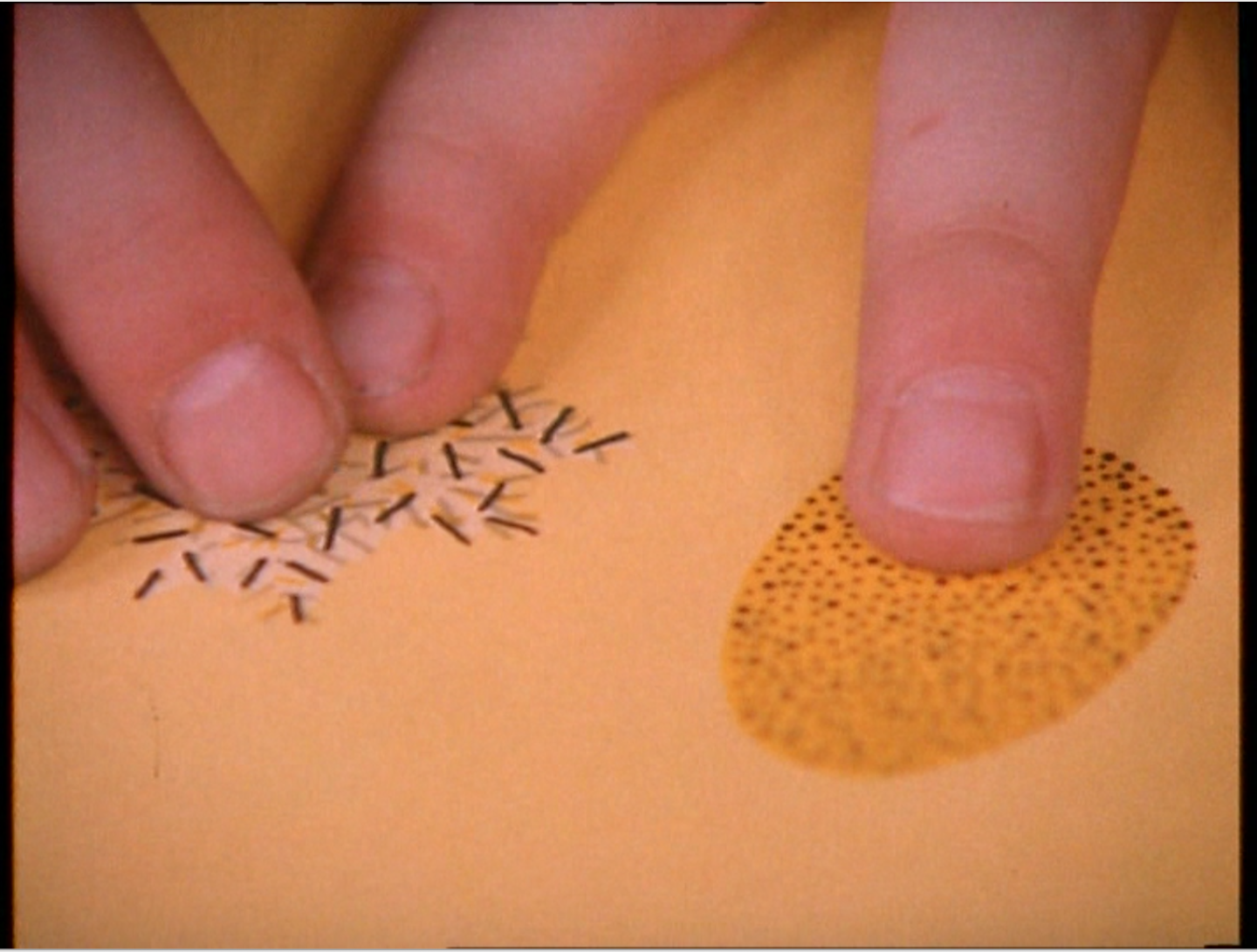
The film opens with a black screen accompanied by voice-over. The children’s spontaneous comments, uttered as they explore the works through touch, fill the auditory space and introduce the viewer to a mode of perception in which visibility is subsumed by darkness. The main section of the 13-minute-and-48-second film consists of alternating sequences: close-up shots of children’s hands examining the works – tracing entire forms and successive fragments – intercut with black screens and voice-over narration. Only in the final minutes does a full shot briefly reveal selected works installed on the gallery walls, accompanied by Winiarski’s aforementioned commentary on the project as a whole. The film concludes with scenes from the vernissage itself, showing guests and participating artists.
Vernissage does not function as documentation of an event. Its subject is tactile perception – rendered and mediated through film in an unprecedented manner. The viewer is confronted with a tactile model of perception and its cognitive outcomes. Significantly, the camera’s movement, following the children’s hands as they traverse the surfaces of the works, evokes filmic impressions traditionally devoted to painting or sculpture, in which the lens glides across the pictorial or sculptural field in close-up. The Waśkos were undoubtedly familiar with such strategies from art films widely circulated in Poland at the time. One of the most frequently discussed examples was Zbigniew Bochenek’s Passacaglia na Kaplicę Zygmuntowską (1966) – a “film poem” devoted to the Sigismund Chapel in the Wawel Castle in Krakow, co-shaped by the music of Krzysztof Penderecki and described by Czeczot-Gawrak as “one of the most original and highly valued achievements of Polish film on art.”16 Władysław Tatarkiewicz emphasized that the film enables the viewer to “see better and more” than would be possible through direct contact with the monument itself.17 What dominates here is the deliberate formation of perception through cinematic visualization. The Waśkos worked in a similar manner in Vernissageto present an alternative mode of experiencing art – through touch.


Alongside scenes depicting the process of tactile exploration, the film confronts close-up, full-frame views of the works – especially their fragments – with the children’s immediate verbal responses. In the first visible sequence, a child runs his fingers across three metal blocks mounted on a wooden base (a work by Tibor Gáyor), allowing the viewer to observe tactile perception as it unfolds: initially in silence and concentration, then accompanied by sounds produced through the manipulation of the object. Through the boy’s actions, the work is made accessible to the film’s audience. In the subsequent scene, another child immerses their fingers in a hanging braid – a work by Naomi Kobayashi – bending the form and grasping its ends. Here, silence intertwines with subtle rustling sounds generated by the activity of learning about the work. This sonification of tactile perception is clearly intensified in the reception of Winiarski’s work. Presented in full frame, it is, in a sense, acoustically activated by the distinct rustling produced as the hand moves across a three-dimensional arrangement of perpendicularly oriented paper rectangles. Touch becomes audible; sound appears to penetrate the structure of the image.18 Yet the most radical formal device employed in the film is the recurring black screen.
The Black Screen
The black screen constitutes one of the fundamental devices of cinematic language. According to Gilles Deleuze, the moment at which the black screen appears does not so much connect images as introduce an interstice between them.19 Richard Misek expands this observation by emphasizing the entanglement of absence and simultaneous presence inherent in the black screen. This tension refers to visual absence and an alternative form of presence conditioned by context, that is, by the specific structure of a given film. As Misek writes, “The localised visual discontinuity that the black screen brings about serves the film’s overall continuity: through separating, it joins.”20 In his film essay The Black Screen, Misek juxtaposes examples in which the black screen functions as a site of affective accumulation, in which separation and connection converge, opening the viewer’s perceptual field to experiences beyond the visual.
A similar function is performed by the black screen in Vernissage. Here, it interrupts the visual documentation of the event that constitutes the film’s subject in order to link the children’s reception of art with an attempt to represent tactile perception itself, which can be apprehended only when the viewer relinquishes the privilege of sight. Such separation of image (or its absence) and sound had previously been employed by Waśko in his films of an analytical, meta-reflective character, created as part of his activity in the Workshop of Film Form. In the nine-minute Okno (Window,1972), he juxtaposed a static shot of a view through a window with sounds emanating from within an apartment – objects being struck, fragments of a radio program, etc. – producing a schizophrenic perceptual condition. As a result, the viewer becomes acutely aware of their own act of seeing.21 Similarly, in his experimental films described as “hypothetical,” the artist tested both the filmic material itself, including its non-representational uses, and the possibility of constructing projections based simultaneously on reality and hypothetical projection.22 In Vernissage, the black screen functions as the culmination of being led into the domain of tactile perception and, through cinematic means, produces a substitute for a new mode of experiencing art – a “hypothetical” haptic perception.
This new experience, however, is not confined to the empirical dimension. Although it is the sense of touch that defines the perceptual difference here, it simultaneously opens up the possibility of a broader understanding of art itself.
In the aforementioned archival description of the film, the Waśkos emphasized the confrontation of two models of “imaginary” states.23 The first, characteristic of conventional perception, is grounded in vision and in intellectual operations engaging the viewer’s prior knowledge. The second is based on a blind child’s embodied, concrete perception, apprehending and interpreting the works “as a world of artistic experiences specific to him.”24 This encounter, as the Waśkos note, reveals “new possibilities for the visual arts” as well as “the special moral meaning of this type of artistic expression.”25 Within this artistic and social experiment, the Waśkos thus recognized and activated the postulates of the avant-garde movements to which they explicitly referred to as artists.
The legacy of the avant-garde – particularly constructivism – formed not only the foundation of the strictly artistic activities of the Workshop of Film Form, but also the subject of documentary films about art produced within this milieu, including Józef Robakowski’s Kompozycje przestrzenne Katarzyny Kobro (Spatial Compositions by Katarzyna Kobro, 1971). It is a symbolic coincidence that Ryszard Waśko conceived the idea for Vernissage while filming material at the Zapiecek Gallery for his documentary devoted to Henryk Stażewski.26 Although Vernissage does not address avant-garde art as its explicit subject, the film itself fully implements avant-garde principles. Through cinematic means – close-ups, fragmentation, the black screen – it affects the viewer’s consciousness, expands their perceptual habits, and constructs knowledge of an alternative mode of reading art: a new language. Within this avant-garde tradition, the motif of the black screen assumes particular significance. It is through this device that climactic moments are introduced, which may be understood as the most advanced attempt to represent tactile perception. Paradoxically, it is precisely the black screen – a tool intrinsic to filmic language and at the same time a negation of film’s visual essence – that enables the experience of touch to become accessible.
The solutions developed by the Waśkos are thus inseparable from the epistemology of the work of art and the social conditions of its reception. In Vernissage, they reconfigure sensual perception within the field of art, undermining the dominance of the visual. Importantly, the aim is not just to demonstrate the possibility of art reception by blind and visually impaired audiences, but to articulate the openness of art itself to multidirectional and multisensory perception.
Another dimension testifies to the work’s social – or, following Jacques Rancière, political – agency: the visibility and audibility of subjects previously excluded from the community of art recipients. In the film, we hear blind children articulate their impressions as immediate responses to the works they touch – a kind of verbal account of recognizing forms and structures. The children identify shapes, yet also stress their ambiguity. In the fourth scene of the film, we hear:
“For me, it’s very incomprehensible. I would say it’s a very disordered world. That’s what I called it. It’s terribly turbulent… You just need to have the imagination for it.”
“No, you have to look at it carefully.”
“Looking” at art through touch unfolds over time and requires the integration of successive elements within the imagination. Art puzzles and intrigues the children, becoming a site of emergent knowledge. They relate what they encounter to familiar experiences, while openly expressing surprise at the discovery of unknown forms. The children’s statements function as a “guide” for the film’s viewers and as the connective tissue binding the entire work together – a structure in which visibility undergoes continuous transformation, at times disappearing entirely into darkness. Their utterances acquire the status of speech acts equal in weight to the image-filled frames themselves (they operate analogously to intertitles appearing on a black screen in silent cinema, which introduced acts of speech essential to narrative development27).Through this strategy, Vernissage reconfigures the distribution of sensual perception and grants audibility to speaking subjects who had previously been denied speech. As a result, the film ultimately generates the conditions for political revaluation.
The Educational Function of Art in the Polish People’s Republic
The Program Department of the Film Board of the Ministry of Culture and Art recognized Vernissage by awarding it a first-degree artistic rating.28 Although the film was subject to standard censorship procedures, no objections were raised. As previously noted, Vernissage contributed to the construction of an image of the state as attentive to the needs of all children, including those with disabilities. Above all, however, it remained fully aligned with the national postulate of egalitarian access to art and with the doctrine of education through art. In socialist Poland, the social function of films on art was understood both as the dissemination of knowledge and as the provision of historical explanations for phenomena considered central to the national cultural heritage. At the same time, art was treated as a tool in educational processes. Henryk Depta – an educator specializing in film education and the author of such publications as Film i wychowanie(Film and Education, 1975) and Kultura filmowa – wychowanie filmowe (Film Culture – Film Education, 1979) – wrote: “Contemporary aesthetic education consists not only in cultivating sensitivity to the beauty of art, but also in shaping – precisely through art – a full and comprehensive human personality.”29 The process of education through art, or more precisely the project of forming the “ideal human of the future” – homo aestheticus – was described in greater detail by Irena Wojnar, whose work focused on the theory of aesthetic education (Estetyka i wychowanie [Aesthetics and Education], 1964; Perspektywy wychowawcze sztuki [Educational Perspectives of Art], 1966; Nauczyciel i wychowanie estetyczne [The Teacher and Aesthetic Education], 1968; Teoria wychowania estetycznego: zarys problematyki [Theory of Aesthetic Education: An Outline of Problems], 1976).30
Aesthetic education was defined as a process of shaping moral attitudes, enriching intellectual development, and cultivating “open perception” alongside creative dispositions. Education conceived in this manner was expected, among other outcomes, to lead to the “discovery of new dimensions of truth about the human being and reality,”31 as well as to greater sensitivity to ethical problems, individual attitudes, and modes of participation in collective life. These objectives were intended to save citizens from the alienation attributed to Western capitalism.32 To this aim, it was necessary to rupture the elitist enclosure within which art had traditionally functioned and to reclaim it for educational purposes. “Therefore, art for education, not education for art,” Wojnar postulated. Within this conceptual framework, film emerged as an ideal instrument for the implementation of this doctrine.33
The social significance of films on art in the People’s Republic of Poland is evidenced not only by the previously mentioned scale of production, but also by regular reviews: the first review of art films was organized in 1958 by the weekly Ekran in collaboration with the National Museum in Warsaw, followed by the International Symposium of Art Films in 1965, and, beginning in 1968, the renowned annual Review of Films on Art in Zakopane.34
As the authors of the book on the history of the Zakopane reviews observed, the role of films about art was to generate an alternative mode of experiencing art – a substitute for “travel, museums, or albums.”35 In contemporary discourse, the value of this alternative model of perception was understood primarily as the possibility of “visual explanation” of the work of art.36 It was this explanatory function that Małgorzata Hendrykowska identified as the defining condition of the genre.37 Polish critics and scholars thus followed the conceptual trajectory outlined by Henri Lemaître, who described films on art as “the art of implication,” capable of liberating what is implied within artworks, immanent yet inaccessible without cinematic mediation.38 Frequently cited were also the views of the French theorist who interpreted films on art as the most complete realization of André Malraux’s concept of the “museum of the imagination,”39 emphasizing both the popularization of works of art and the opportunity to perceive previously unseen aspects of them. In 1972, Depta underscored the fundamental role of film in “teaching how to look at a work of art.”40 Film thus came to function as a medium of art perception, which guided, structured, and shaped the act of viewing.
Against this backdrop, Vernissage remains an exceptional production, although it was not the only film focusing on tactile perception of art. In Kazimierz Mucha’s well-known Abakany (1970), the camera directs the viewer’s gaze across the textured surfaces of Magdalena Abakanowicz’s sculptural forms. Through a sequence of close-up shots, “touch is realized successively, in a manner characteristic of this sense and distinct from the immediate synthesis available to vision.”41 The introduction of haptic vision – to invoke Alois Riegl’s concept – offers an alternative to the dominance of visual centrism, yet ultimately does not transcend the sovereignty of the eye. The unprecedented character of Vernissage, by contrast, lies in its presentation of a model of art perception emancipated from vision itself and in its potential to reconfigure the very field of art recipients.
The Tactile Disarmament of Art History
The hypertrophic eye of art history as an academic discipline has dominated the remaining senses almost from the moment of its institutional formation. Founded on the premise of purified visual observation, art history became one of the many agents reinforcing the visual centrism of modernity. As Donald Preziosi has argued, the very concept of modernity is constructed through the systems of visual organization of public museums.42 Meanwhile, research conducted by anthropologists Constance Classen and David Howes demonstrates that tactile engagement with objects was practiced by museum audiences in early institutions such as the Ashmolean Museum and the British Museum.43 According to their thesis, the transformation of reception models resulted not only from the growing authority of visualization techniques within scientific practice, but also from the pressures exerted by industrial capitalism and the regimes of surveillance and control intrinsic to it. In other words, this peculiar disciplining of perception was linked both to the emerging positivist paradigm of science and to the normative systems imposed by modern economic and social structures. It should be emphasized, however, that touch was not entirely eliminated from art reception. Rather, it remained accessible to privileged groups – connoisseurs, collectors, and museum professionals.44 For this reason, enabling tactile access to artworks for non-privileged audiences cannot be understood merely as the implementation of accessibility policies introduced in Polish cultural institutions by means of an act of 19 July 2019. The stakes are considerably higher. What is at issue is not only the expansion of the community of art audiences, but also – particularly from the perspective of art historians – the necessity of rethinking the very foundations of the discipline itself.
The “tactile wedge” appeared relatively early within art-historical thought. In The Florentine Painters of the Renaissance (1896), Bernard Berenson emphasized that it is the sense of touch that guarantees the perception of space and objects. However, he did not refer to literal tangibility, but rather to tactile values projected onto retinal impressions – to the activation of consciousness through what he termed “tactile imagination.”45 The notion of “haptic vision” subsequently gained currency in art history through the writings of Alois Riegl and later Gilles Deleuze. Like Berenson, they both wrote not about actual touch, but tactile qualities mobilized by vision. Riegl associated hapticity with works that resist the illusion of three-dimensional depth, such as Egyptian reliefs, whose planar structure necessitates close viewing.46 Deleuze, in his fascinating book Francis Bacon: The Logic of Sensation, employs hapticity to describe a particular mode of experiencing painting47 – one that suspends the classical division between figure and background and privileges tactile sensation constructed “on the basis of the texture and material qualities of the painted object, independently of perspective and the suggestion of chiaroscuro depth.”48
Both Riegl’s and Deleuze’s reflections articulate a distinct epistemological position. The Austrian scholar emphasized that only “experiences of the sense of touch evoked more than any other means of human experiences the idea of a material existence of the objects.”49 At the same time, “haptic vision” presupposes the active and subjective participation of the perceiving subject, whose cognition is based on visual impressions multiplied and synthesized within thought. Through this process, an image emerges of a haptic, impenetrable external surface of “an independent and enclosed individuality.”50 Deleuze goes considerably further. Drawing on Bergson, he seeks “a domain in which the difference between the consciousness of the subject and objects, as articulated in transcendental philosophy, no longer applies.”51 Despite their fundamental differences, both theoretical positions converge in their portrayal of an actively perceiving subject. Hapticity functions here both as an immanent property of the work of art (Riegl) and as a category describing a specific perceptual process (Riegl and Deleuze). In each case, however, hapticity remains a conceptualized form of touch that never becomes actual. In other words: haptic vision refers exclusively to a hypothetical touch that does not truly occur.
This hypothetical touch – contrasted here with real tactile experience – can be situated within the broader framework of Western philosophy, which established its epistemic order through a sharp division between privileged intellectual cognition and empirical knowledge. Georgina Kleege, an important representative of disability studies, analyzes the figure of the blind man in the writings of Descartes, John Locke, and even Denis Diderot as a “hypothetical blind man” functioning as a “prop for theories of consciousness.”52 This figure is questioned primarily about visual phenomena, such as perspective or color, about the recognition of form, and even about optical devices. As Kleege observes, the primary function of the hypothetical blind man “is to highlight the importance of sight and to elicit a frisson of awe and pity which promotes gratitude among the sighted theorists for the vision they possess.”53 By confronting such speculative constructions with the lived experiences of individuals possessing diverse forms of visual impairment, Kleege dismantles the dominant philosophical image of blindness. She urges us to abandon the binary opposition between blindness and sight, pointing, for example, to the case of a blind scholar of visual culture. It should also be emphasized that visual impairment encompasses a wide spectrum of sensory experiences, ranging from complete blindness to partial sight, as reflected in distinctions between blind, visually impaired, and partially sighted individuals.
At the beginning of the twenty-first century, the tactile wedge driven into the humanities opened new perspectives for art history, largely under the influence of contemporary art practices explicitly engaging multisensory perception. It was in dialogue with such artistic strategies that scholars including Laura U. Marks – and, in the Polish context, Marta Smolińska – reconsidered dominant models of art reception.54 This shift challenged the Cartesian separation of intellectual and empirical knowledge that persists within academic discourse and remains deeply embedded in Western cultural traditions. At the same time, these studies may be situated within a broader phenomenon: the revalorization of touch and its expansion within “postmodern European culture focused on bodily sensations.”55. Dorota Angutek links this transformation to the possibility of transdisciplinary research grounded in collaboration between the social and biological sciences. In art history, it would be equally important to pursue such forms of research and to shift attention towards lived, tactile perception, which resists reduction to generalized or essentialist models. Touch has its own cultural and historical specificity, shaped by gender, social position, and temperament.56 It may function as a tool of cognition and exploration, but also as a source of pleasure. Understood in these varied ways, it has long played a role in the history of art reception.
These considerations do not imply a call to equalize the status of touch and sight, nor to negate the dominant role of vision. Rather, following the research of Fiona Candlin as well as Classen and Howes,57 art history is afforded an opportunity to critically reassess its own foundations – rooted in the modern reification of sight – in favor of a more capacious understanding of art perception and, consequently, of the writing of its history.


A contribution to such reflection may be found in Vernissage, in which the Waśkos reveal the significance of tactile perception for both blind and sighted audiences. By thematizing the openness of art to plural and multisensory modes of reception, the film successfully inserts a tactile wedge into the field of art history. Its emphasis on real, rather than hypothetical or privileged touch, renders a group of blind children vocal subjects of art history.
The agency of touch in revising dominant cultural and social structures is well known from feminist interventions in art history.58 Candlin rightly cautions, however, that – much as in discourses surrounding participatory art – there exists a risk of reproducing conventional sensory hierarchies. As she notes, the assumption that “touch is a means of exploring subjectivities or knowledge outside of rational, visual, modern and/or patriarchal art history [is] entirely congruent with the art histories which establish those models.”59
Disability as a Critical Category in Art History
In his studies of various forms of disability in art history, Tobin Siebers proposes treating disability as an aesthetic value. On this basis, he demonstrates the participation of disability in systems of knowledge and emphasizes its critical potential. By analyzing representations of disability in modern art, Siebers questions the aesthetic assumptions that have long dominated art-historical discourse.60 Within this framework, disability is neither merely a subject of artistic representation, nor solely a matter of individual experience subsequently translated into artistic form; nor can it be reduced to political declaration. As Siebers writes, “It is all of these things, but it is more.”61
Following my argument, considerations of art accessibility for people with visual impairments should extend beyond the issue of access for a marginalized group to encompass broader questions of equality and social diversity. This involves both advocacy on behalf of audiences with visual impairments and an opportunity for sighted viewers – including art historians – to revise narratives long regarded as indisputable truths. The expanding field of disability studies focuses on “how disability operates in culture and on how the discourses of disability, race, gender, and sexuality intermingle to create figures of otherness from the raw materials of bodily variation.”62 Since the revisionist turn initiated in the 1970s, art history has increasingly stressed identity-based stratifications within both artistic production and its audiences, introducing feminist, postcolonial, and queer interventions, as well as broader frameworks of situated knowledge. Within the previously discussed critique of the hypothetical blind man, one can discern an impulse to recognize the speech of blind individuals – not as the voice of the Other, whose perception deviates from that of the normative, sighted subject, nor as a deviation from the supposedly neutral construct of the hypothetical viewer produced by art history. What is at stake instead is the acknowledgment of the speech act of a subject who experiences art differently. Naturally, such a subject perceives art under conditions distinct from those of sighted viewers, particularly with regard to the legibility of visual codes. Yet this alternative mode of perception may introduce new qualities into the history of art reception. The question that remains unresolved is whether art history is prepared to confront the perception of a real blind person. The postulate of a social reorganization of the community of art recipients must therefore be articulated explicitly – not only through interdisciplinary collaboration, but also through the coordinated efforts of researchers, critics, museum professionals, curators, and educators. Such a reconfiguration would open the possibility for art historians to formulate new research questions.
Meaningful Experience
Within Polish art history, the most well-known example of an artistic action aligned with this project is Andrzej Pawłowski’s Stymulatory wrażeń nieadekwatnych (Stimulators of Inadequate Sensations, 1963–1964), which confronts the incongruity between visual and tactile perception. The viewer standing before the box experienced a discrepancy between what was seen through the peephole and what was perceived through touch.63 Although the work was intended for sighted audiences, its central theme extends beyond perceptual disturbance caused by contradictory stimuli. At its core lies the confrontation between different sensory modalities themselves. A similar perspective may be applied to the singular oeuvre of Maria Bartuszová, a Slovak sculptor whose “biomorphic and haptic sculptures” engaged tactile perception to function, among other roles, as “dialectical tools” for teaching haptic orientation or physical principles such as gravity.64 In this case, touch served to integrate art with everyday life and practical knowledge. I am not reluctant to hypothesize that similar works and strategies may be identified far more frequently within art history than is commonly assumed. Vernissage itself should be understood as one of the manifestations through which artists have expanded the field of perception – an expansion that, as emphasized earlier, entails real tactile engagement while widening the art audience.


The exhibition at the Zapiecek Gallery constituted one of the earliest initiatives of this kind in communist Poland.65 During the 1980s, the popular press reported on exhibitions by blind artists, including Stanisław Hermanowicz; painter Józefa Budzyn-Nowakowa, a student of Jacek Malczewski; and sculptor Sławomir Spychalski, a student of Xawery Dunikowski. A particularly significant undertaking supported by institutional authority was the exhibition project by Bronisław Chromy, which presented both the artist’s own works and tactile copies of sculptures – including Nike, Madonna and Child by Donatello, the Wawel Heads – as well as architectural models of monuments. This exhibition was preceded by theoretical classes conducted by Włodzimierz Hodys with blind participants. The entire project was discussed in detail during the first conference devoted to making art accessible to blind audiences, organized in 1983 at the Royal Castle in Warsaw in cooperation with the Center in Laski and the Polish Association of the Blind (PZN).66 More than one hundred participants from across Poland – including museum curators, teachers, and PZN activists – took part. The central issue recurring in nearly every contribution was the place of art within the education of blind children.67 Proposed solutions included the organization of training exhibitions in schools and traveling exhibitions prepared by museums. Other participants advocated regular museum visits, emphasizing the importance of architectural space, ambient sounds, and even smells. Repeated contact with art and the possibility of returning to familiar objects were regarded as fundamental. The need to ensure access not only to aesthetic education, but to the possibility of “experiencing” and “feeling” art, was strongly emphasized.68 Yet it is precisely this “meaningful” experience of art – grounded in affective response – that art historians have long regarded with suspicion. As Georges Didi-Huberman has correctly argued, the object of art-historical inquiry is metaphorically “killed” by scholars69 so that it may be subjected to analytical examination, akin to an autopsy. Perhaps, then, the marginalization of tactile perception among blind audiences is rooted in a far deeper anxiety: the fear that art might be resurrected, regaining its social vitality and agency. This potential scenario is echoed in Monika Bogusławska’s 1984 account of the reception of an exhibition of Allen Eaton’s collection:
The idea of viewing it together proved very successful. The blind and the sighted inspired one another. Through the sharing of deeply personal experiences, closer relationships were formed. It turned out that joint viewing of the collection fostered the joy of discovering differences and similarities between people, brought them closer together, and generated mutual respect.70
Conclusion
The growing number of initiatives currently undertaken in Poland to develop specific methods of making art accessible to people with visual impairments has begun to acquire the status of a separate cultural phenomenon. This process was partially outlined in the thematic issue of Kultura Współczesna published in 2021,71 yet it undoubtedly requires further systematic study. The proposals with which I am familiar concentrate primarily on the effectiveness of particular models, as well as on the objectives and strategies of reaching blind audiences. These debates inevitably echo long-standing art-historical disputes concerning the methods of analyzing works of art, centered on iconography, historical context, phenomenological experience, and social conditioning. But must the formal analysis of a work of art necessarily be bound by the rigor of objective observation? Should our goal really be to convey only a semblance of the experience of a work of art? It is possible, however, that the discourse on accessibility should begin with an entirely different question: How might reflection on the practice of making art accessible to people with visual impairments transform the attitudes of art historians themselves?
Bibliography
Angutek, Dorota. “Świadomość, samoświadomość, jaźń a zmysł haptyczny w kontekstach kultury i biologii.” Etnografia. Praktyki, Teorie, Doświadczenia, no. 4 (2018): 41–60.
Archiwum Wytwórni Filmów Oświatowych, Łódź. File: Wernisaż 2994/15.
Azoulay, Ariella Aïsha. Potential History: Unlearning Imperialism. London and New York: Verso, 2019.
Berenson, Bernard. The Florentine Painters of the Renaissance. New York: G. P. Putnam’s Sons, 1896.
Candlin, Fiona. Art, Museums and Touch. Manchester: Manchester University Press, 2010.
Chatterjee, Helen, ed. Touch in Museums: Policy and Practice in Object Handling. Oxford: Berg, 2008.
Classen, Constance, ed. The Deepest Sense: A Cultural History of Touch. Urbana: University of Illinois Press, 2012.
———, ed. The Book of Touch. London: Routledge, 2005.
Czeczot-Gawrak, Zbigniew. Filmowa prezentacja sztuki: architektura, malarstwo, rzeźba, grafika, sztuka ludowa, rzemiosło artystyczne. Warsaw: Wydawnictwa Szkolne i Pedagogiczne, 1979.
———. Film o sztuce. Nowe zjawiska kultury artystycznej. Warsaw: Polska Akademia Nauk, Instytut Sztuki, 1974.
Depta, Henryk. “Film o sztuce w wychowaniu estetycznym.” Muzealnictwo, no. 20 (1972): 76–86.
Deleuze, Gilles. Francis Bacon: The Logic of Sensation. Translated by Daniel W. Smith. Minneapolis: University of Minnesota Press, 2002.
———. Cinema 1: The Movement-Image. Translated by Hugh Tomlinson and Barbara Habberjam. Minneapolis: University of Minnesota Press, 1986.
———. Cinema 2: The Time-Image. Translated by Hugh Tomlinson and Robert Galeta. Minneapolis: University of Minnesota Press, 1989.
Didi-Huberman, Georges. Before the Image: The Question Concerning the Ends of a Certain History of Art. Translated by John Goodman. University Park: Pennsylvania State University Press, 2020.
Edwards, Elizabeth, Chris Gosden, and Ruth B. Phillips, eds. Sensible Objects: Colonialism, Museums and Material Culture. Oxford: Berg, 2006.
Garland-Thomson, Rosemarie. Extraordinary Bodies: Figuring Physical Disability in American Culture and Literature. New York: Columbia University Press, 1997.
Garlatyová, Gabriela, ed. Maria Bartuszová: Catalogue Raisonné. Košice: The Archive of Maria Bartuszová, 2022.
Hendrykowska, Małgorzata. Elementy wyjaśniania w filmie o sztuce. Poznań: Wydawnictwo Naukowe UAM, 1988.
Howes, David, and Constance Classen, eds. Ways of Sensing. London: Routledge, 2013.
Kleege, Georgina. “Blindness and Visual Culture: An Eyewitness Account.” Journal of Visual Culture 4, no. 2 (2005).
Lipiński, Filip. “Czynić widzialnym. Film jako poszerzone, wirtualne pole dzieła sztuki.” Kwartalnik Filmowy, no. 97–98 (2017): 250–62.
Lipiński, Filip, and Dorota Łuczak. “Polskie dokumentalne filmy o sztuce 1945–1989.” In Historia sztuki na co dzień, edited by Jarosław Jarzewicz and Janusz Pazder. Warsaw: Stowarzyszenie Historyków Sztuki, 2018.
Łuczak, Dorota. Foto-oko. Wizja fotograficzna wobec okularocentryzmu w sztuce I połowy XX wieku. Kraków: Universitas, 2018.
Przegląd Tyflologiczny, no. 1 (1984).
Marks, Laura U. Touch: Sensuous Theory and Multisensory Media. Minneapolis: University of Minnesota Press, 2002.
Misek, Richard. “The Black Screen.” In Indefinite Visions, edited by Martine Beugnet, Allan Cameron, and Arild Fetveit. Edinburgh: Edinburgh University Press, 2017.
Paterson, Mark. The Senses of Touch: Haptics, Affects and Technologies. Oxford: Berg, 2007.
Pawłowska, Aneta, and Julia Sowińska-Heim. Audiodeskrypcja dzieł sztuki: metody, problemy, przykłady. Łódź: Wydawnictwo Uniwersytetu Łódzkiego, 2016.
Piwocki, Ksawery. Pierwsza nowoczesna teoria sztuki. Poglądy Aloisa Riegla. Warsaw: Państwowe Wydawnictwo Naukowe, 1970.
Poprzęcka, Maria, ed. Wielkie dzieła – wielkie interpretacje. Materiały z Ogólnopolskiej sesji naukowej Stowarzyszenia Historyków Sztuki. Warsaw: Stowarzyszenie Historyków Sztuki, 2006.
Preziosi, Donald. “Modernity Again: The Museum as Trompe L’oeil.” In Deconstruction and the Visual Arts: Art, Media, Architecture, edited by Peter Brunette and David Wills. Cambridge: Cambridge University Press, 1994.
Przybył-Sadowska, Elżbieta. Triuno. Instytucje we wspólnocie Lasek 1911–1961. Kraków: LIBRON, 2015.
Rancière, Jacques. Aesthetics and Its Discontents. Cambridge; Malden, MA: Polity Press, 2009.
Ronduda, Łukasz. The Workshop of the Film Form: Film Realisations from the Years 1970–1977. http://www.exchange-gallery.pl/english/wff.html.
Sęczkowska, Barbara, and Leszek Sosnowski. Przygody filmu ze sztuką. Z dziejów Zakopiańskich Przeglądów. Kraków: Dyskusyjny Klub Filmowy Kinematograf, 1986.
Siebers, Tobin. Disability Aesthetics. Ann Arbor: University of Michigan Press, 2010.
Smolińska, Marta. Haptyczność poszerzona: zmysł dotyku w sztuce polskiej drugiej połowy XX i początku XXI wieku. Kraków: Universitas, 2020.
Tatarkiewicz, Władysław. “Z powodu filmu o kaplicy Zygmuntowskiej.” Film, no. 5 (1969).
Więckowski, Robert. Sztuka prezentowania sztuki. Warsaw: Narodowy Instytut Muzealnictwa i Ochrony Zbiorów.https://www.nim.gov.pl/files//articles/147/Sztuka_prezentowania_sztuki.pdf.
Wojnar, Iwona. “Sztuka i wychowanie.” Studia Pedagogiczne, no. 20 (1970): 181–201.
- Jacques Rancière, Aesthetics and Its Discontents (Cambridge; Malden, MA: Polity Press, 2009), 25. ↩︎
- Application for production approval, 19 January 1980, Wernisaż 2994/15, Wytwórnia Filmów Oświatowych w Łodzi. ↩︎
- According to archival documentation, the screenplay was written by Maria Waśko; director: Ryszard Waśko; cinematographer: Lechosław Czołnowski; production manager: Andrzej Traczynowski; editor: Teresa Ziemska, general film production set: 23 January 1980, Wernisaż 2994/W, Wytwórnia Filmów Oświatowych w Łodzi. ↩︎
- The fate of the collection remains unknown. According to employees’ declarations, the works are no longer held at the institution. No relevant documentation has survived. It is nevertheless certain that a copy of the Waśkos’ film must once have been kept at the Center, as evidenced by a letter preserved in the WFO archive. Letter to WFO director Zbigniew Godlewski, 28 February 1980, Wernisaż 2994/W, Wytwórnia Filmów Oświatowych w Łodzi. ↩︎
- Documentary films on art produced during the period of the Polish People’s Republic have attracted considerable interest among film scholars. The most important studies include: Maria Hendrykowska, Elementy wyjaśniania w filmie o sztuce (Poznań: Wydawnictwo Naukowe UAM, 1988); Zofia Czeczot-Gawrak, Film o sztuce. Nowe zjawiska kultury artystycznej (Wrocław: Polska Akademia Nauk, Instytut Sztuki, 1974); Barbara Sęczkowska and Leszek Sosnowski, Przygody filmu ze sztuką. Z dziejów Zakopiańskich Przeglądów (Kraków: Dyskusyjny Klub Filmowy „Kinematograf”, 1986). The film Vernissage was first discussed in a text co-authored by myself and Filip Lipiński: Filip Lipiński and Dorota Łuczak, “Polskie dokumentalne filmy o sztuce 1945–1989,” in Historia sztuki na co dzień, ed. Jarosław Jarzewicz and Justyna Pazder (Poznań: Stowarzyszenie Historyków Sztuki, 2018), 11–24. ↩︎
- The research project Polski film dokumentalny o sztuce 1945–1989 (Polish Documentary Film on Art, 1945–1989) was conducted at the Institute of Art History, Adam Mickiewicz University in Poznań, between 2012 and 2015. The grant, funded within the National Programme for the Development of the Humanities, was led by Professor Piotr Juszkiewicz. The project resulted in the creation of a database of films about art available at the Institute, as well as scholarly articles by Piotr Juszkiewicz, Ewa Jarosz, Filip Lipiński, and Dorota Łuczak. ↩︎
- Ariella Aïsha Azoulay, Potential History: Unlearning Imperialism (London and New York: Verso, 2019), 289. ↩︎
- Ibid., 290. ↩︎
- Rancière, Aesthetics and Its Discontents, 24. ↩︎
- Ibid., 25. ↩︎
- Ibid. ↩︎
- Lipiński and Łuczak, “Polskie dokumentalne filmy o sztuce 1945–1989.” ↩︎
- Filip Lipiński, “Czynić widzialnym. Film jako poszerzone, wirtualne pole dzieła sztuki,” Kwartalnik Filmowy 2017, nos. 97–98: 250–262, esp. 251. ↩︎
- The idea of organizing an exhibition of contemporary art for children from the Educational Center in Laski corresponded with the institution’s educational program. Since the founding of the Institute for the Blind by the Society for the Care of the Blind in 1921 – at the initiative of Blessed Róża Czacka – its primary mission remained education and rehabilitation. On this subject, see: Elżbieta Przybył-Sadowska, Triuno. Instytucje we wspólnocie Lasek 1911–1961 (Kraków: LIBRON, 2015), which also includes an extensive bibliography concerning the institution’s activity during the socialist period. I would like to thank Katarzyna Głowacka for reading for me a text written in Braille and published in the exhibition catalogue. ↩︎
- Maria Waśko and Ryszard Waśko, novella for the film Wernisaż, Wernisaż 2994/15, Wytwórnia Filmów Oświatowych w Łodzi. ↩︎
- Zofia Czeczot-Gawrak, Filmowe spotkania…, 119; Lipiński and Łuczak, “Polskie dokumentalne filmy o sztuce 1945–1989.” ↩︎
- Władysław Tatarkiewicz, “Z powodu filmu o kaplicy Zygmuntowskiej,” Film 1969, no. 5; Lipiński and Łuczak, “Polskie dokumentalne filmy o sztuce 1945–1989.” ↩︎
- Screenplay for the film Wernisaż, Wernisaż 2994/15, Wytwórnia Filmów Oświatowych w Łodzi. ↩︎
- Gilles Deleuze, Cinema 1: The Movement-Image, trans. Hugh Tomlinson and Barbara Habberjam (Minneapolis: University of Minnesota Press, 1986), 193. ↩︎
- Richard Misek, “The Black Screen,” in Indefinite Visions, ed. Martine Beugnet, Allan Cameron, and Arild Fetveit (Edinburgh: Edinburgh University Press, 2017), 38–52, quotation at 39. I thank Dr Grażyna Świętochowska for drawing my attention to Misek’s work. ↩︎
- Łukasz Ronduda, The Workshop of the Film Form. Film Realisations from the Years 1970–1977, http://www.exchange-gallery.pl/english/wff.html (accessed 10 June 2025). ↩︎
- Ibid. ↩︎
- Waśko and Waśko, novella for the film Wernisaż. ↩︎
- Ibid. ↩︎
- Ibid. ↩︎
- Letter from Teresa Oziemska to the Economic Evaluation Committee of the Educational Film Studio, 11 December 1980, Wernisaż 2994/15, Wytwórnia Filmów Oświatowych w Łodzi. ↩︎
- Deleuze, Cinema 1. ↩︎
- Document dated 15 February 1980, issued by the Ministry of Culture and Art and signed by Danuta Czarska, Deputy Director of the Programming Department, Wernisaż 2994/15, Wytwórnia Filmów Oświatowych w Łodzi. ↩︎
- Helena Depta, “Film o sztuce w wychowaniu estetycznym,” Muzealnictwo 1972, no. 20: 76–86, quotation at 81. ↩︎
- Irena Wojnar, “Sztuka i wychowanie,” Studia Pedagogiczne 1970, vol. 20: 181–201, see 200. ↩︎
- Ibid., 197. ↩︎
- Ibid., 183. ↩︎
- Lipiński and Łuczak, “Polskie dokumentalne filmy o sztuce 1945–1989.” ↩︎
- Ibid. ↩︎
- Barbara Sęczkowska and Leszek Sosnowski, Przygody filmu ze sztuką, 33. ↩︎
- Czeczot-Gawrak, Film o sztuce, 62. ↩︎
- Hendrykowska, Elementy wyjaśniania w filmie o sztuce, 13–18. ↩︎
- Ibid., 61–62; Henri Lemaitre, Beaux-Arts et cinéma (Paris: Éditions du Cerf, 1956). ↩︎
- See, for example: Depta, “Film o sztuce,” 85; Zofia Czeczot-Gawrak, Filmowa prezentacja sztuki (Warsaw, 1979), 17. ↩︎
- Depta, “Film o sztuce,” 76–77. ↩︎
- Lipiński and Łuczak, “Polskie dokumentalne filmy o sztuce 1945–1989.” ↩︎
- Donald Preziosi, “Modernity Again: The Museum as Trompe L’Oeil,” in Deconstruction and the Visual Arts: Art, Media, Architecture, ed. Peter Brunette and David Wills (Cambridge: Cambridge University Press, 1994), 146; see also Fiona Candlin, Art, Museum and Touch(Manchester and New York: Manchester University Press, 2010), 60. ↩︎
- Fiona Candlin, “Museum, Modernity and the Class Politics of Touching Objects,” in Touch in Museums: Policy and Practice in Object Handling, ed. Helen J. Chatterjee (Oxford and New York: Berg, 2008), 10; Constance Classen and David Howes, “The Museum as Sensescape,” in Sensible Objects, ed. Elizabeth Edwards, Chris Gosden, and Ruth Phillips (Oxford and New York: Berg, 2006), 192–222. ↩︎
- Ibid. ↩︎
- Bernard Berenson, The Florentine Painters of the Renaissance (New York and London, 1896); Dorota Łuczak, Foto-oko. Wizja fotograficzna wobec okularocentryzmu w sztuce I połowy XX wieku (Kraków: TAiWPN Universitas, 2018), 301. ↩︎
- Alois Riegl, Late Roman Art Industry, trans. Rolf Winkes, Rome, 1985; Łuczak, Foto-oko, 301–306. ↩︎
- Gilles Deleuze, Francis Bacon: The Logic of Sensation, trans. Daniel W. Smith (Minneapolis: University of Minnesota Press, 2002); Łuczak, Foto-oko. ↩︎
- Łukasz Kiepuszewski, “Trzecie oko. Haptyczne widzenie według Deleuze’a,” in Wielkie dzieła – wielkie interpretacje, ed. Maria Poprzęcka (Warsaw, 2006), 256. ↩︎
- Riegl, Late Roman Art Industry, 73. ↩︎
- Ibid., 45. ↩︎
- Kiepuszewski, “Trzecie oko,” 251. ↩︎
- Georgina Kleege, “Blindness and Visual Culture: An Eyewitness Account,” Journal of Visual Culture 4, no. 2 (2005). ↩︎
- Ibid., 180. ↩︎
- Laura U. Marks, Touch: Sensuous Theory and Multisensory Media (Minneapolis and London: University of Minnesota Press, 2002); Magdalena Smolińska, Haptyczność poszerzona (Kraków: TAiWPN Universitas, 2020); see also Mark Paterson, The Senses of Touch (Oxford and New York: Berg, 2007). ↩︎
- Dorota Angutek, “Świadomość, samoświadomość, jaźń a zmysł haptyczny,” Etnografia 2018, no. 4: 41–60. ↩︎
- Candlin, Art, Museum and Touch, 188. ↩︎
- Ibid.; Classen and Howes, “The Museum as Sensescape”; The Book of Touch, ed. Constance Classen (London and New York: Routledge, 2005); The Deepest Sense, ed. Constance Classen (Urbana: University of Illinois Press, 2012); Ways of Sensing, ed. David Howes and Constance Classen (London and New York: Routledge, 2013). ↩︎
- Candlin, Art, Museum and Touch, 187. ↩︎
- The Waśkos also fell into this trap in their description of the film, distinguishing – as mentioned earlier – between intellectual and empirical modes of art reception. In the film itself, this division is no longer present. ↩︎
- Tobin Siebers, Disability Aesthetics (Ann Arbor: University of Michigan Press, 2010). ↩︎
- Ibid., 20. ↩︎
- Rosemarie Garland-Thomson, Extraordinary Bodies: Figuring Physical Disability in American Culture and Literature (New York: Columbia University Press, 1997), 6. ↩︎
- Smolińska, Haptyczność poszerzona, 10–13. ↩︎
- Gabriela Garlatyová, “Biomorphic and Haptic Sculptures from 1965 to 1970,” in Maria Bartuszová: Catalogue Raisonné, ed. Garlatyová (Košice: The Archive of Maria Bartuszová, 2022), 108. ↩︎
- In 1977 an exhibition of miniatures was held at Zachęta. During the 1970s, accessibility programs for blind audiences were implemented by the National Archaeological Museum in Warsaw. In 1983, at the first Polish conference devoted to accessibility of art for blind audiences, Monika Bogusławska referred to early international examples (Tate Gallery, London, 1976 and 1982; South African National Gallery, Cape Town, 1967; Musée d’Art et d’Essai, Paris, 1982). For more on accessibility in Polish museums in the early 1980s, see Przegląd Tyflologiczny 1984, no. 1. ↩︎
- Bronisław Chromy, “Udostępnianie rzeźby niewidomym,” Przegląd Tyflologiczny 1984, no. 1: 55–63. I thank Dr Paweł Ignaczak of the Royal Castle in Warsaw for assistance in locating the conference materials. ↩︎
- Conference papers and discussion transcripts published in Przegląd Tyflologiczny 1984, no. 1. ↩︎
- Józef Mendruń, “Jak poznajemy – oglądanie dotykowe a wzrokowe,” Przegląd Tyflologiczny 1984, no. 1: 32–38. ↩︎
- Georges Didi-Huberman, Confronting Images: Questioning the Ends of a Certain History of Art, trans. John Goodman (University Park, PA: Pennsylvania State University Press, 2005), 47. ↩︎
- Monika Bogusławska, “Muzeum dla niewidomych,” Przegląd Tyflologiczny 1984, no. 1: 39–44, quotation at 40. ↩︎
- Rafał Więckowski, “Sztuka prezentowania sztuki,” Narodowy Instytut Muzealnictwa i Ochrony Zbiorów (https://www.nimoz.pl/files//articles/147/Sztuka_prezentowania_sztuki.pdf, accessed 10 January 2025), Kultura Współczesna 2021, no. 3, See also: R. Więckowski, Sztuka prezentowania sztuki, Kultura bez barier, Narodowy Instytut Muzealnictwa i Ochrony Zbiorów (https://www.nimoz.pl/files//articles/147/Sztuka_prezentowania_sztuki.pdf, accessed 10 January 2025); Anna Pawłowska and Joanna Sowińska-Heim, Audiodeskrypcja dzieł sztuki (Łódź: Wydawnictwo Uniwersytetu Łódzkiego, 2016). Among pioneering exhibitions in democratic Poland was Piękno dotyku, organized by the Silesian Museum in 2011 in cooperation with the Homer Museum in Ancona. It would be difficult to list here all the accessibility programs accompanying exhibitions in recent years. A recent example fully designed for blind audiences is Dotyk sztuki / Touch of Art, Centrum Spotkania Kultur w Lublinie, 2023, curated by Anna Barańska and Rafał Skóra. ↩︎
Dorota Łuczak
Dorota Łuczak is a PhD in art history and an Assistant Professor at the Institute of Art History, Adam Mickiewicz University in Poznań, where she also serves as Head of the Modern and Contemporary Art History Research Unit. She is an editor of the journal Artium Quaestiones. She has been a recipient of research fellowships from the Corbridge Trust (University of Cambridge), the French Government, the Stiftung Preußischer Kulturbesitz, and the Lanckoroński Foundation.
Her research focuses on the history and theory of photography in the twentieth and twenty-first centuries. In 2018, she published the monograph Foto-oko: Photographic Vision and Ocularcentrism in Art of the First Half of the Twentieth Century. She is a co-author of Polish Photographers, Critics, and Theorists on Photography, 1839–1989: An Anthology(2023). She has authored numerous articles on modern and contemporary photography published in journals such as History of Photography, Photography & Culture, Artium Quaestiones, Sztuka i Dokumentacja, Porównania, and Kwartalnik Fotografia, as well as in monographs and exhibition catalogues. She is currently working on a book devoted to the reproduction of works of art in the People’s Republic of Poland.


