Title
The Global Journey of “Art of the Socialist Era”: The History of the International Exhibition „30 Victorious Years” (1973–1980) Based on Polish Archival Sources
https://doi.org/10.48285/ASPWAW29564158.MCE.2025.11.2en
exhibition histories, socialist globalism, socialist realism, Central Bureau of Artistic Exhibitions
https://miejsce.asp.waw.pl/en/globalna-podroz-sztuki-epoki-socjalizmu/
Abstract
This article presents archival research on the global circulation of the international exhibition „Thirty Victorious Years” during the 1970s, which involved ten socialist countries: Bulgaria, Czechoslovakia, Cuba, Mongolia, the GDR, Poland, Romania, Hungary, Vietnam, and the USSR. Its first opening took place in Moscow (1975), followed by one in Warsaw (1977), and its final presentation in Ulaanbaatar (1978). The analyses situate the exhibition within contemporary art-historical interest in “socialist internationalism” and in revising art history through the lens of exhibitions organized under state socialism. The exhibition is interpreted as an example of the “centralized planning” of the realist art canon, encompassing socialist countries across Europe, Asia, and Latin America.
Keywords
exhibition histories, socialist globalism, socialist realism, Central Bureau of Artistic Exhibitions
DOI
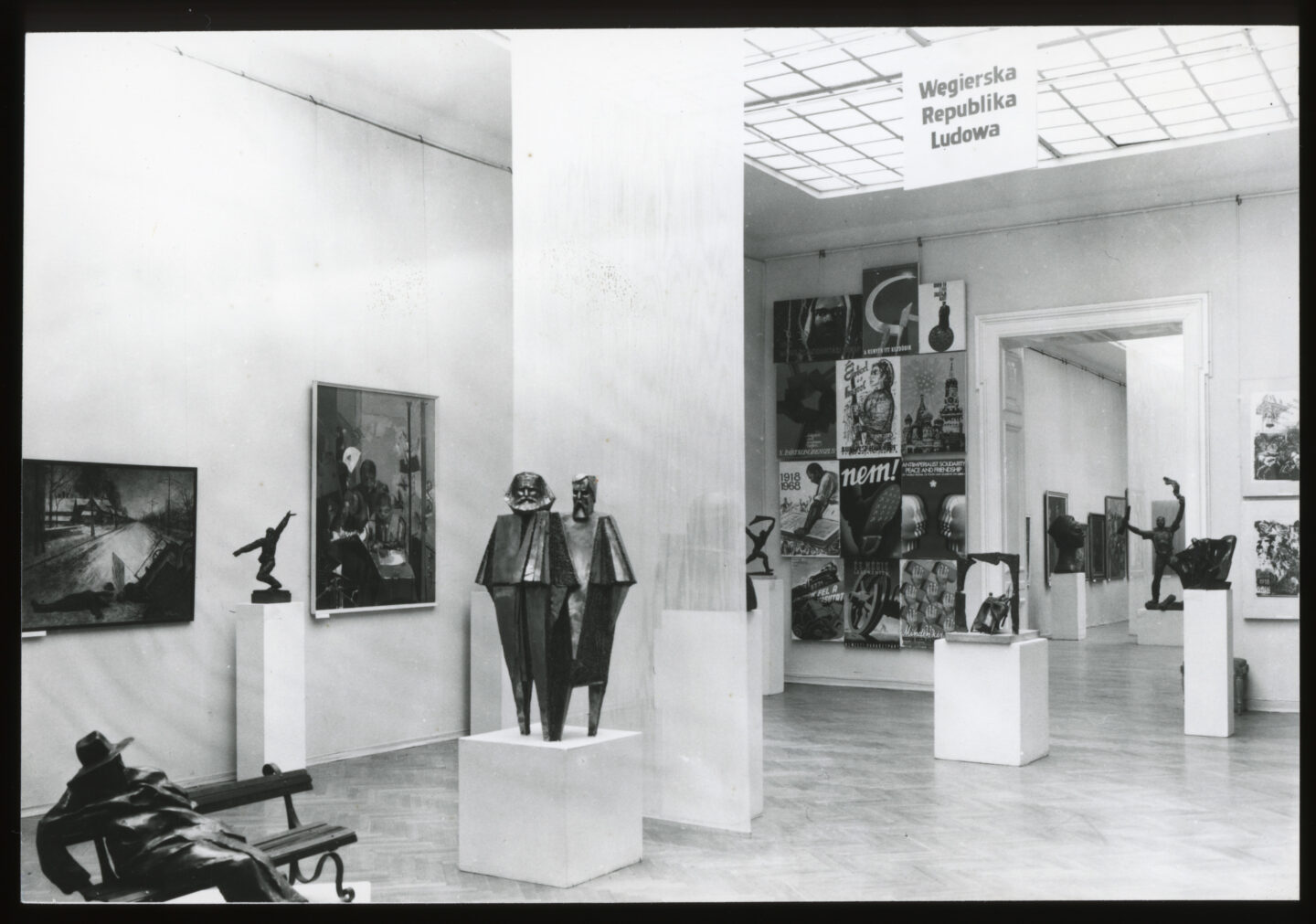
“At the Zachęta, preparations are underway for the exhibition […] 30 Victorious Years, and for the reception of foreign delegations. […] The entire Zachęta is filled. On the ground floor, there is a retrospective […], and upstairs, there are expositions of Czechoslovakia, Bulgaria, Cuba, Romania, Poland, Hungary, Vietnam, Mongolia, East Germany and the USSR. […] The flags of ten countries are already flying in front of the Zachęta.”1
Introduction
30 Victorious Years. International Art Exhibition [30 zwycięskich lat. Międzynarodowa wystawa sztuki] is the title of an exhibition whose origins are linked to the 5th Conference of Ministers of Culture of Socialist Countries in Havana (29–31 May 1973). The chronological framework given in the title of this article, 1973–1980, covers the entire period of the exhibition’s organization – from its conception to its dismantling. The exhibition was shown in Moscow (27 June – 10 August 1975), and its subsequent editions took place in Berlin (30 September 1975 – 6 January 1976), Prague (1 April – 16 May 1976), Budapest (25 June – 25 July 1976), Sofia and Plovdiv (26 August – 20 November 1976), and Bucharest (18 January – 27 February 1977). From 5 April to 1 May 1977, the exhibition was presented at Centralne Biuro Wystaw Artystycznych [Central Bureau of Art Exhibitions, CBWA] in Warsaw. In June 1977, the CBWA transferred the exhibition to Berlin; from there, it was transported to Rostock, from where it sailed to Cuba. The exhibition was presented in Havana from 8 March to 7 April 1978, and then transported from Cuba to Leningrad, from where it set off by land to Mongolia. In December 1978, in Ulaanbaatar, it was loaded onto wagons and sent to Moscow, from where individual countries collected their exhibits using their own transport in 1979. In the first quarter of 1980, the CBWA was still dealing with the return of works by Polish artists loaned to Moscow in 1975.
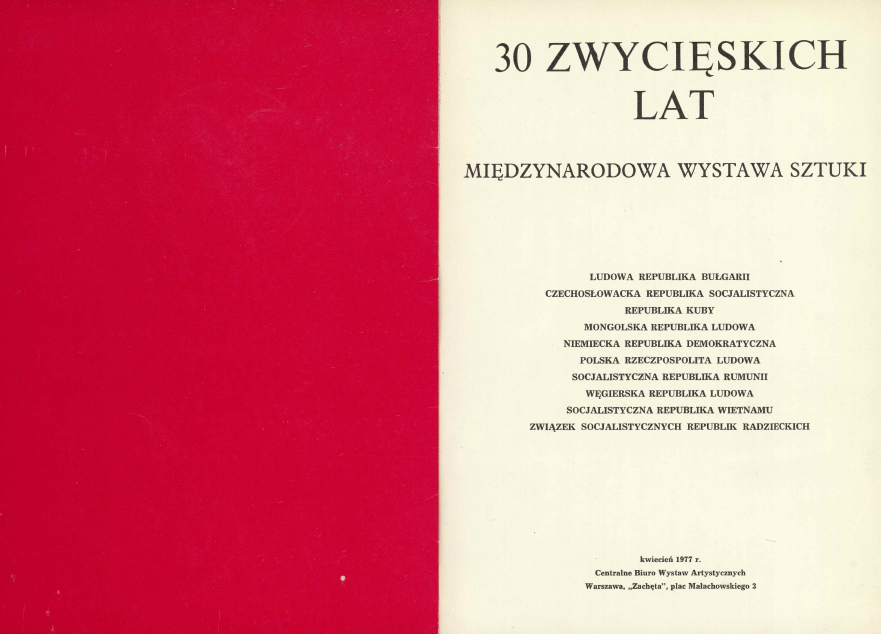
„Thirty Victorious Years. International Art Exhibition”, CBWA, Warsaw, 1977, exhibition catalogue [text section]. Source: https://zacheta.art.pl/public/upload/mediateka/pdf/64f8a35db9e84.pdf.
This article is an extension of research on the circulation of this exhibition in the global Eastern Bloc and its political and art-historical significance.2 The analyses are based on materials from the archives of the Zachęta – National Gallery of Art, such as the above-mentioned diary of Mieczysław Ptaśnik (director of the CBWA in 1977–1989), reports from official trips by representatives of Polish authorities and cultural institutions to conferences of ministers of socialist countries and meetings of the international organizing committee of the exhibition, plans of exhibitions in Moscow, Berlin, Prague, and Budapest, photographs of the exhibition in Warsaw, reviews from Polish, Soviet, German, and Romanian press, along with photographs of selected works, a two-volume catalog accompanying the Warsaw exhibition, as well as correspondence sent to the Culture Department of the Central Committee of the Polish United Worker’s Party (KC PZPR) from the Department of Cultural Cooperation with Foreign Countries of the Ministry of Culture and Art, deposited in the Central Archives of Modern Records in Warsaw.
In contemporary Polish research on international cultural contacts, 30 Victorious Years: International Art Exhibition – especially its Warsaw edition in 1977 – is mentioned as “the only large-scale joint presentation of visual arts from the socialist camp,” which was preceded by the International Exhibition of Art of Socialist Countries, opened in Moscow in 1958.3 The latter exhibition has been the subject of numerous analyses, focusing primarily on the “diplomatic scandal” surrounding the Polish section, which included (admittedly few) abstract works and paintings by the Colorists.4 However, most of the 206 works listed in the catalog of the Polish section of this exhibition were works whose themes and style were in line with the principles of socialist realism.5 The exhibition 30 Victorious Years, organized fifteen years later, did not receive as much attention from researchers, even though it had similar ideological assumptions, organizational structure, and geopolitical significance.
The chronology and geographical scope of 30 Victorious Years outlined above prompt deeper reflection on this enormous political and artistic undertaking, which involved state authorities and political parties, ministries, diplomatic missions, museums, and other official institutions from ten countries of the socialist bloc. This article provides a chronological overview of documents preserved in Warsaw archives, which have not yet been included in research on international exchange exhibitions in the People’s Republic of Poland. This overview allows us, first of all, to sketch the circumstances surrounding the creation of the exhibition concept in 1973–1975, from the Conference of Ministers of Culture in Havana to the first unveiling at the Manege in Moscow. Secondly, most of the sources cited below concern the logistical aspect of the exhibition, which, unlike the 1958 exhibition, circulated across three continents over a period of five years. It is not often in the history of exhibitions that logistical factors and related financial aspects are analyzed: this makes it all the more worthwhile to emphasize the fact that the organization of large exhibitions in the so-called official circuit in the Eastern Bloc was carried out in times of central economic planning on the basis of international cooperation agreements. Not only top-down decisions or the selection of works by national commissioners, but also the financial capabilities and efficiency of the institutions responsible for the organization, as well as the exhibition, technical, and transport conditions, influenced the shape of the presentation in individual countries. Thirdly, only after presenting the circumstances that forced, for example, changes in the number of works, is it possible to ask the key question about the significance of the exhibition 30 Victorious Years in the cultural policy of the Eastern Bloc as a presentation of the canon of “art of the socialist era” in the 1970s.6 Due to the scope and type of available sources, this article presents comments primarily concerning the Polish section, treating them as a point of departure for research on other national sections.
I see the exhibition 30 Victorious Years as an example of cultural diplomacy of authoritarian state socialism, but also as an attempt at politically imposed historicization of socialist realism and consolidation of the importance of realism in the art of the Eastern Bloc. My research on the international exhibition of ten socialist countries, which traveled across three continents, is thus part of contemporary revisionist interests in the institutional circulation of art.7 These revisions contest the identification of globalization with Western modernization, raising questions about how socialist internationalism, ideas of cooperation, solidarity, and equality among nations influenced the ways in which art histories were written, and international culture exchange programs, including visual arts exhibitions, were planned during the Cold War.8 They can be described as a shift from research focused on post-war artistic contacts in the European Eastern Bloc – and on the contacts of this area with Western European countries – to analyses questioning the political division of the world into two main blocs and problematizing the links between socialist internationalism and global decolonization processes.9 Contemporary art-historical revisions, including the history of exhibitions, also assume the need to confront the so-called unofficial circulation, including (neo-)avant-garde trends, with the official circulation, which consisted of presentations of top-down promoted socialist realism and its continuation. The aim of reflecting on this kind of “socialist globalism” is not only to undermine the hegemony of the so-called North-Atlantic canon (the art of Western Europe and the United States),10 but also to highlight the political and institutional conditions of art in socialists countries, taking into account the diverse nature and rhythm of modernization processes.
The Concept of the Exhibition, 1973–1975
The first opening of the exhibition 30 Victorious Years took place in Moscow on 27 June 1975. However, as previously mentioned, the concept originated at the 5th Conference of Ministers of Culture of Socialist Countries in Havana in 1973. In a memo on the exhibition prepared for the Central Committee of the Polish United Worker’s Party around 1976, we read that “the idea behind this project was to commemorate the 30th anniversary of the victory over fascism with a great joint political and artistic manifestation of the countries of our camp.”11 Before the opening in Moscow’s Manege, an International Organizing Committee for the Exhibition was established, whose meetings in Bratislava were coordinated by the Ministry of Culture of the Slovak Socialist Republic (SSR). The general concept was developed during committee meetings attended by ministers, deputy ministers or other officials authorized by them, representatives of cultural institutions and artists’ associations (on the Polish side, it was usually the director of the Department of Fine Arts at the Ministry of Culture and Art, other representatives of the ministry and the CBWA). The abovementioned memo summarized the stages of the concept’s development:
Originally, the intention was to organize an exhibition dedicated to the “30th anniversary of victory over fascism,” emphasizing the period of martyrdom and the victorious struggle of nations. In the course of the committee’s further activities, it was considered more appropriate and expedient to demonstrate the political, social, economic, and cultural transformations achieved in socialist countries after the historic victory. However, it was decided to devote a separate section of the display, inaugurating the exhibition, to the period of struggle and martyrdom of nations, creating an international retrospective part. Thus, the exhibition’s title was set as “30 Victorious Years.”12
At a meeting of the International Organizing Committee for the Exhibition in Pezinok near Bratislava in June 1974, the decisions of the Conference of Ministers of Culture of Socialist Countries were reported, and a schedule for work on subsequent openings was established. The Organizing Committee was informed that at the meeting of ministers in Havana, it had been decided to postpone the opening of the exhibition in Moscow until June 1975, as in May of that year, the 30th anniversary of victory over fascism was to be celebrated with the opening of the All-Union Exhibition of the USSR.13 In June 1974, a working committee was also established, chaired by the director of the Art Department of the Ministry of Culture of the Slovak Socialist Republic, with representatives of the ministries of culture of Slovakia, Czechoslovakia, East Germany, and the USSR as members. The next meeting of the Organizing Committee was scheduled for October 1974, when it was going to approve materials for the catalog. The Committee was also to conduct a “review of the exhibition before its opening” at a meeting in Moscow in June 1975.14
Already at the ministers’ conference in Havana in 1973, the Bulgarian delegation proposed organizing a joint “retrospective” section within the exhibition, bringing together works depicting the history of the fight against fascism in all countries participating in the exhibition. In June 1974, this proposal was accepted by the Organizing Committee, which entrusted the development of the concept for the retrospective section and the appointment of its commissioner to representatives of the USSR. The USSR Ministry of Culture undertook to present the name of the commissioner and the “ideological concept” of the retrospective section (introducing the entire exhibition) to the committee chairman by 1 August 1974. The area of the retrospective section was also preliminarily determined; in Moscow, approximately 400–600 m2 was allocated for it.
In addition to the space allocated for the retrospective section (featuring selected works from all participating countries), each country (except for the USSR) was allocated approximately 400 m² of separate exhibition space at the Manege in Moscow. After the exhibition in Moscow, the entire exhibition was to be reduced to an area of 2,000 m² so that it could be shown in countries that did not have as much space as the Manege.15 The original plan was to transport the exhibition, reduced by about half, from Moscow to Bucharest, then to Sofia, Budapest, Warsaw, Berlin, and Prague. In Czechoslovakia, the exhibition was to be reduced a second time to enable its transport by air to Cuba. After the exhibition in Havana, the works were to be sent to Vietnam and Mongolia via Moscow. In each country, the exhibition was to last no more than six weeks. At a meeting of the Organizing Committee in June 1974, it was agreed that each country would bear the costs of preparing and transporting the exhibition to Moscow, the costs of organizing it in its own institution, including architectural design and insurance of exhibits for the entire intercontinental route.16 It was proposed to create a joint fund to pay for transport to Cuba, Mongolia, and Vietnam, which was to be discussed between the ministers of culture and finance of each country.17
By 1 August 1974, the ministries of culture were required to submit the names of the commissioners for the national sections to the Organizing Committee. Their duties included selecting works and preparing exhibition design, selecting works for the catalog, sending a list of works to Moscow, participating in installations in Moscow and subsequent cities on the exhibition tour, as well as participating in selecting works to be transported to other European countries, as well as to Cuba, Mongolia, and Vietnam.18 As early as 1974, during the deliberations of the Organizing Committee, the USSR delegation declared its readiness to print a catalog consisting of two parts: illustrations and text. It was finally decided that the volume containing illustrations would be printed in Moscow in 100,000 copies, and the text section in each of the participating countries.19 In June 1974, the USSR delegation undertook to present a mock-up of the catalog at the next Committee meeting in October 1974. It was also mentioned that Hungary would make a short propaganda film about the exhibition.20
In July 1974, following the decisions of the Organizing Committee, the Department of Art of the Ministry of Culture and Art sent a letter to the CBWA informing them that Poland’s participation in 30 Victorious Years had been included in the Ministry’s central exhibition plan for 1975. The CBWA was also notified of the appointment (by the deputy minister) of Jerzy Zanoziński of the National Museum in Warsaw as the national commissioner of the exhibition.21
The third meeting of the Organizing Committee, held in Bratislava in November 1974, was attended by representatives from the USSR, East Germany, Czechoslovakia, Hungary, Bulgaria, Poland, and Slovakia, the host country. Delegations from Romania, Cuba, Mongolia, and Vietnam were absent.22 The working committee presented for approval an ideological introduction common to all countries, while the Soviet delegation proposed a concept for the retrospective part of the exhibition.23 However, they did not present a mock-up of the illustrative part of the catalog, as the Czech Republic, Bulgaria, Romania, Cuba, Mongolia, and Vietnam did not send the required materials to Moscow on time. The CSR and Bulgarian delegations were obliged to meet the new deadline of 15 December 1974. The delegations from Cuba, Mongolia, and Vietnam were to be urged by correspondence, and, as noted in the report, “the Soviet delegation will address the above matter directly” with Romania.24
At the fourth meeting of the Organizing Committee in Bratislava (4–5 February 1975), representatives from Romania, Cuba, Mongolia, and Vietnam were once again absent.25 As these countries had not yet submitted their materials for the catalog, the problems related to its printing were discussed again. In order to “ensure that all countries were included,” it was decided that representatives of the Organizing Committee in East Germany would travel to Vietnam, representatives of the USSR to Mongolia, representatives of Czechoslovakia to Cuba, and a Polish delegation to Romania. If these direct efforts were unsuccessful by 1 March 1975, the Committee authorized the Moscow publishing house to “compile materials at its own discretion based on documentation available in the USSR” or to “begin printing without material documenting the national sections of the above-mentioned countries.”26
At the meeting in February 1975, the retrospective section was also discussed, the script for which was developed by the Soviet side on the basis of works proposed by all countries.27 A new route for the exhibition and a schedule of openings were agreed upon. The place and date of the first opening (Moscow, June 1975) remained unchanged. In June 1974, it was assumed that the exhibition would travel from Moscow to Bucharest first, but due to the absence of the Romanian delegation at previous committee meetings, the second exhibition was planned in Berlin and the third in Sofia. The East Germany and Bulgaria allocated large spaces for the exhibition; it was decided that after the presentation in Sofia, the number of exhibits in the national sections will be halved and send either to Budapest or Bucharest:
Assuming that Romania would participate, but taking into account the absence of its delegation at the meeting, it was decided to offer the organizers of the Bucharest exhibition two dates to choose from. Accepting the first one as more convenient due to its geographical location, the 4th exhibition would take place in Budapest [opening around 3 April 1976 – G. Ś.], and the 5th exhibition in Bucharest [opening around 10 June 1976]. The second proposal assumes the reverse order.28
The exhibition was then to travel to Prague (opening around 20 September 1976) and from Prague to Warsaw (opening around 5 February 1977). It was planned that ten national sections would be presented in the Zachęta building in Warsaw, and the retrospective section in the nearby gallery of the Union of Polish Artists.29 After the Warsaw exhibition, a second reduction of the exhibition size was planned, by about half of the exhibits, in order to adapt it to the exhibition capabilities of non-European countries.30 The above schedule shows that in February 1975, five months before the opening of the exhibition in Moscow, Romania’s participation had not yet been confirmed: “In the event that Romania’s participation in the exhibition does not materialize or it decides not to exhibit in its own country, the order of presentation and schedule, starting with the fifth exhibition, will be determined at a meeting of the International Organizing Committee for the Exhibition in Moscow in early June this year.”31
The next meeting of the Organizing Committee (Moscow, 25–26 April 1975) was attended by the deputy director of the CBWA (as organizational director) and the commissioner of the Polish section.32 In addition to representatives of the Polish People’s Republic, delegations from the USSR, Bulgaria, Hungary, East Germany, Cuba, Mongolia, Czechoslovakia, and Romania (only on April 26) were present. The Polish delegation’s report did not mention Vietnam’s presence, but compared to previous meetings, it seems that political pressure had the desired effect, i.e., the almost complete representation of the countries participating in the exhibition. On 25 April, a meeting was held at the Manege, whose exhibition space (as stated in the report) was approximately 6,000 m2. The exhibition was started with a retrospective section, and the national sections were arranged according to the Russian alphabet: Vietnam, Bulgaria, Hungary, East Germany, Cuba, Mongolia, Poland, Romania, Czechoslovakia, and the Soviet Union.33
Organizational commissioners and exhibition commissioners from the respective countries were responsible for the assembly and disassembly of the national sections. During the assembly in the Manege in June 1975, the commissioner of the Polish section decided to reduce the number of works on display due to insufficient wall space.34 At that time, the Polish section had 98 exhibits. Poland proposed eight paintings and 22 posters for the retrospective section, but this section was also reduced due to insufficient space and changes in the concept made by the Soviet commissioner.35
Circulation of the Exhibition in European Socialist Countries, 1975–1977
The grand opening in Moscow was preceded by a meeting of the Organizing Committee (25 June 1975), the laying of wreaths at Lenin’s Mausoleum and the Tomb of the Unknown Soldier, and a press conference (26 June). In an internal report from the delegation to Moscow, Konstanty Węgrzyn, director of the Department of Art at the Ministry of Culture and Art, wrote explicitly about the many “perturbations and troubles” caused by the Soviet side: “The organizers from the USSR did not announce the opening date until the last minute (9 days before).”36 He also reported on the unofficial opinions of the delegates and their disappointment that “the first joint manifestation of socialist countries was not given the rank of at least ministers of culture” (the guests were welcomed by the Soviet deputy minister).37 Węgrzyn assessed not only the manner of displaying the Polish section in the Manege, but also the selection of works made by the exhibition curator: “The Polish exhibition stood out primarily for its moderation.”38 And yet one Polish painting caused concern in Moscow:
Relatively few paintings on the theme of war, but carefully selected (Poles in Berlin, Lenin, etc.), several old ones – Lenin’s stay in Poland. The emphasis was placed on paintings showing the changes in the early years (agricultural reform, land parceling, shock workers, etc.). Other paintings dealt with the so-called reality. […] Our exhibition was viewed very carefully by all delegations and journalists […]. Only one painting (by Nowosielski – a woman in a bathing costume against the backdrop of the city) sparked discussion and questions, even directed at me with a suggestion to replace this painting. I did not consider it necessary to make changes, both in order to emphasize full autonomy and to avoid further discussion after the removal of the above-mentioned painting.39
The director recommended that the Polish sections of subsequent exhibitions be prepared with the same care as in Moscow and that the opening in Warsaw, planned for 1977, be given the highest priority. At the same time, however, he requested that in the future, “similar concepts to the Moscow exhibition should not be supported due to the excessive commitment involved and the effect not always being commensurate with the intended one.”40 The commissioner of the Polish section also expressed a critical opinion. As he pointed out, the entire exhibition at the Manege consisted of approximately 1,400 works, and “this is probably its greatest weakness.”41
The logistics of the exhibition were also undoubtedly a weakness. During dismantling at the Manege (18–20 August 1975), the Soviet organizers offered to transport the exhibits to Berlin for the Polish team in a tarpaulin-covered vehicle. The Polish side requested a vehicle suitable for the transport of works of art. The Soviet side initially claimed that this was not possible, but in the end, metal-covered trucks were brought in from Leningrad.42 The vast majority of works in the Polish section were borrowed from museum collections, including works known from the National Art Exhibitions (1950–1954). Among the works sent to Moscow were Wojciech Weiss’s Manifest [Manifesto] (1940, National Museum in Warsaw), Felicjan Szczęsny Kowarski’s Górnik Wincenty Pstrowski [Miner Wincenty Pstrowski] (1948, National Museum in Warsaw), and flagship works of socialist realism: Eugeniusz Eibisch’s Lenin i Spójnia [Lenin and “Spójnia”](1952, Lenin Museum), Zbigniew Pronaszko’s Reforma rolna [Agricultural Reform] (1952/1953, National Museum in Warsaw), Andrzej Strumiłło’s Nasza ziemia [Our Land] (1954, Lubusz Land Museum in Zielona Góra), as well as paintings by Xawery Dunikowski, Bronisław Wojciech Linke, and Jan Cybis.43
After the exhibition in Moscow, the Polish organizers planned to withdraw some of the exhibits from further travel, e.g., Kowarski’s painting Górnik Wincenty Pstrowski [Miner Wincenty Pstrowski], Andrzej Wróblewski’s Na zebraniu [At the Meeting] (1953), Benon Liberski’s Chemostal I (1966), Jerzy Nowosielski’s Akt z pejzażem [Nude with Landscape] (1969), Tadeusz Dominik’s woodcut Macierzyństwo [Motherhood] (1955) and Jerzy Panek’s Manifest PKWN [Manifesto of the Polish Committee of National Liberation] (1954).44 Some of the works required conservation, and it was also necessary to reduce the total number of works to be presented in Berlin. Miner Wincenty Pstrowski ultimately traveled to Berlin, but temperature and humidity fluctuations in the Altes Museum adversely affected the condition of almost all of the exhibits.45
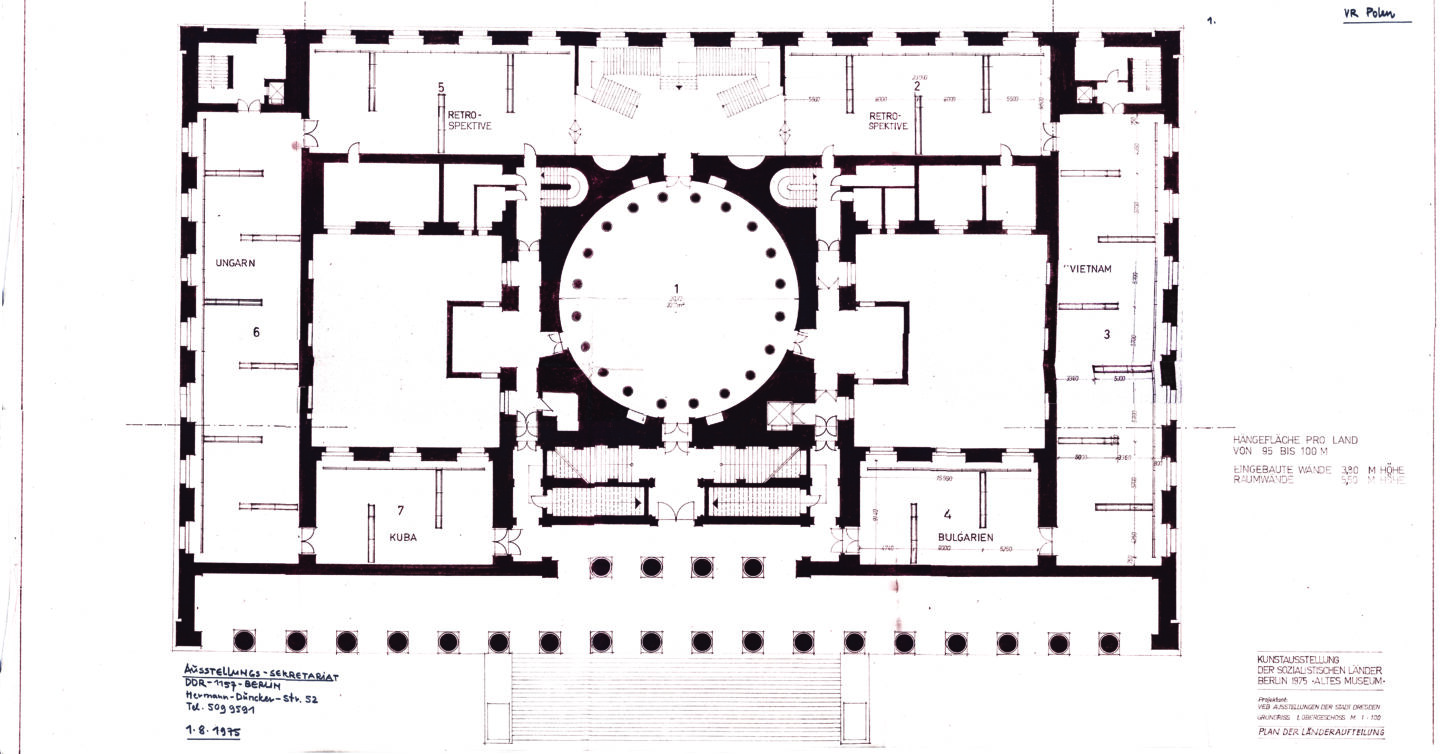
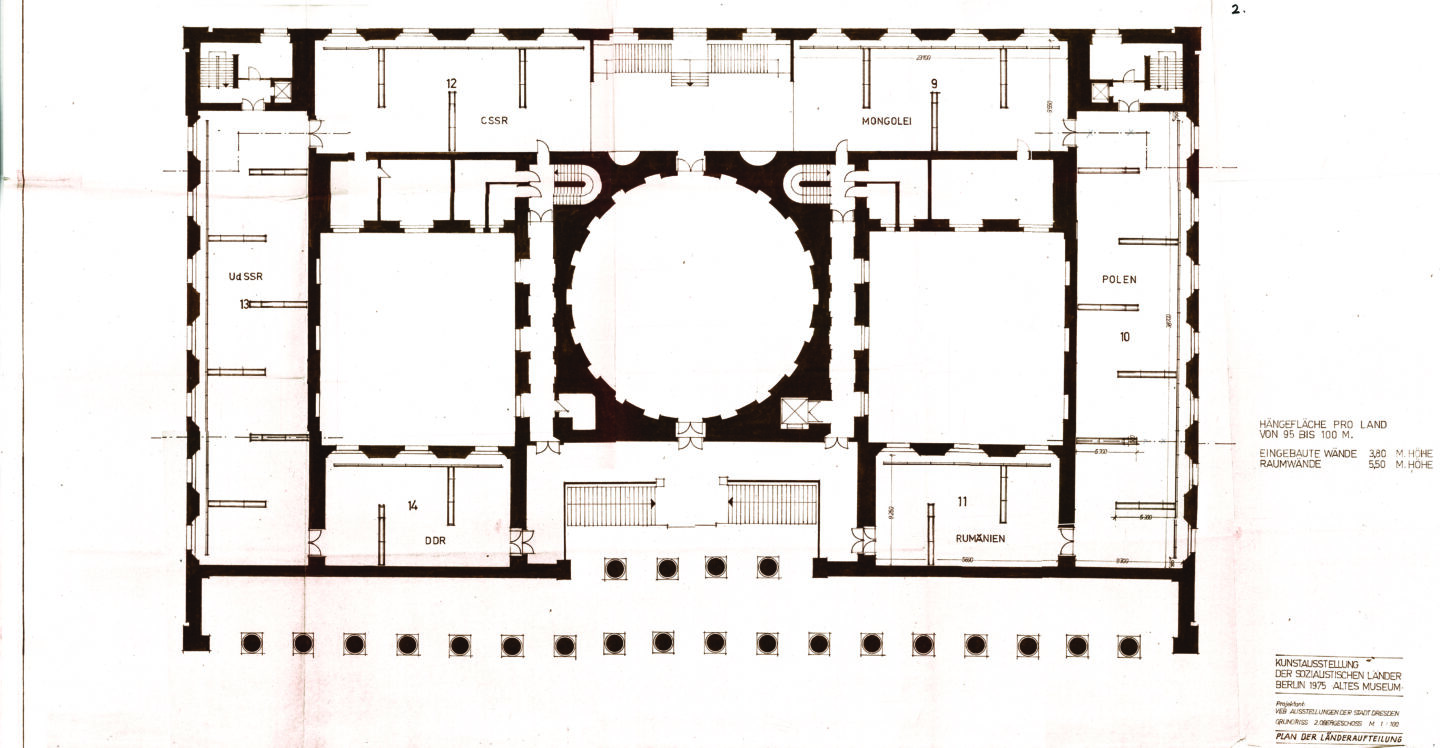
On the first floor of the Altes Museum, in the enfilade rooms surrounding the central “pantheon,” a retrospective section and sections of Vietnam, Bulgaria, Cuba, and Hungary were presented. The upper floor housed sections of Mongolia, Poland, Romania, East Germany, the USSR, and Czechoslovakia.46 The report by the delegation from the Ministry of Culture and Art stated that the exhibition in Berlin was visited by approximately 115,000 people. The event was accompanied by a scientific session devoted to “achievements of contemporary art in socialist countries.”47
After the next opening, on 1 April 1976 in Prague, the Polish delegation reported that the section dedicated to the People’s Republic of Poland was “discriminated against.” It was placed in narrow corridor rooms, and the space allocated to it was much smaller than that of other countries.48 In the report by a representative of the Department of Art of the Ministry of Culture and Art, we find comments about “terrible exhibition conditions”: “the graphic art section is extremely crowded, [works] hung in three or even four rows, in a place separated from visitors by a wide platform.”49 Five Polish sculptures were also placed in the corridor, without providing them adequate “breathing room.” The organisers of the neighbouring GDR section proposed granting Poland part of their exhibition space; however, the Czechoslovak side opposed this, despite the exhibition regulations guaranteeing equal exhibition space to each participating country.50 The dispute over exhibition conditions between the Polish and Czech sides seemed so intense that tense relations between the Polish ministry and the Department of Art and Music of the Ministry of Culture of the Czechoslovak Socialist Republic were expected to continue.51
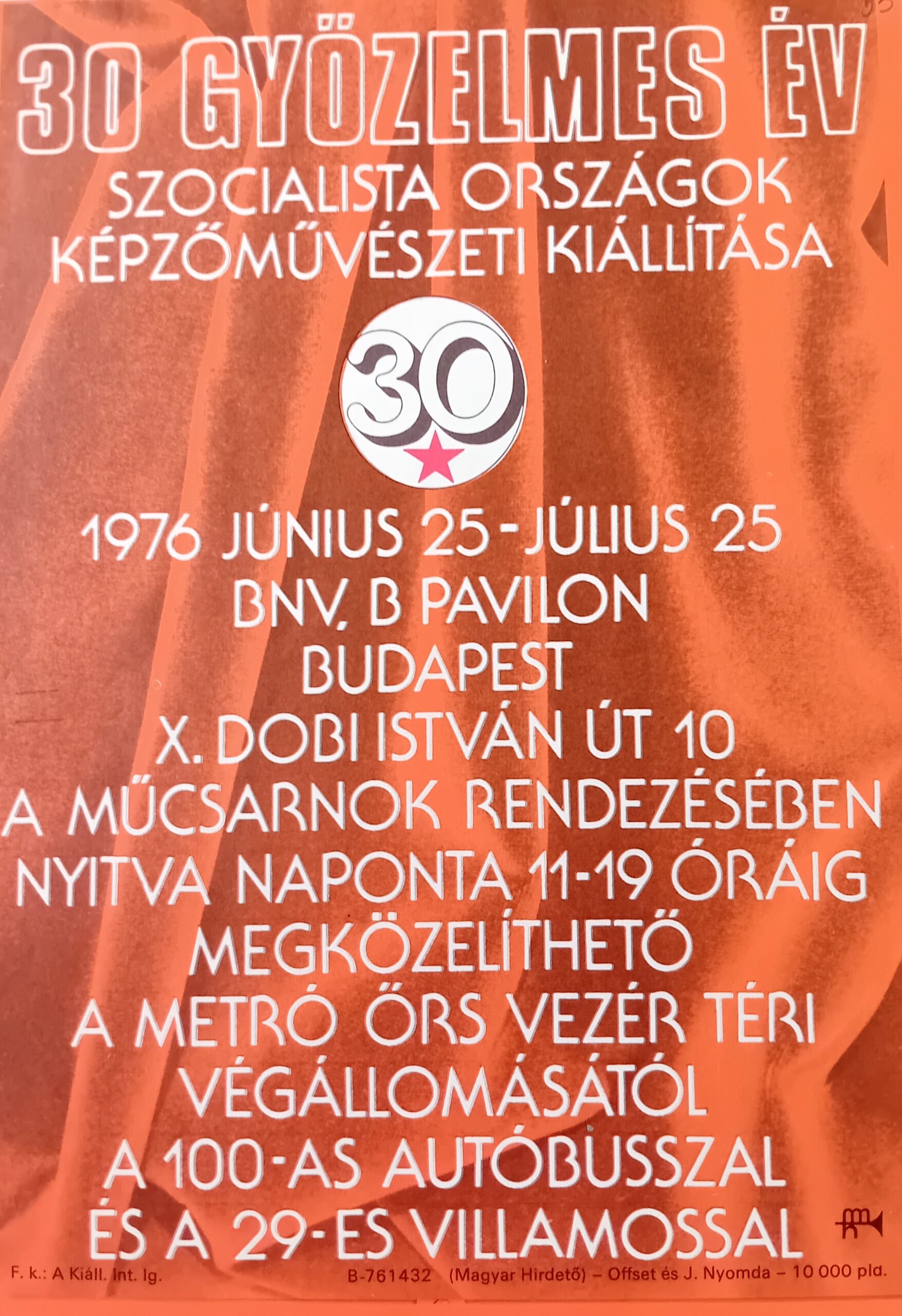
Poster of „Thirty Victorious Years”, Budapest (25 June – 25 July 1976). Source: Zachęta – National Gallery of Art, Warsaw, CBWA, „Thirty Victorious Years” Exhibition 1975–1977, Vol. II, file 3197. Photo courtesy of Zachęta – National Gallery of Art, Warsaw.
At the beginning of June 1976, the exhibition was moved from Prague to Budapest.52 In pavilion “B” of the International Fair, approximately 220 m2 of space was allocated to each country, which is why, before the exhibition in Budapest, the curator of the Polish section increased the number of exhibits by six sculptures and fourteen paintings.53 Among others, the following works were added: Alfons Karny’s sculpture Pielęgniarka [Nurse](1971), Mieczysław Welter’s model of the Monument to the Victims of Fascism in Sobibór (1965), Gustaw Zemła’s sculpture Uniesiona dłoń[Raised Hand] (1973), and paintings: Gazownię na Woli [Wola Gasworks] (1963) by Maria Anto, Martwa natura z rakietą [Still Life with a Rocket] (1970) by Kiejstut Bereźnicki, W murze [In the Wall] (1970) by Zbylut Grzywacz, Górska droga [Mountain Road] (1970) and Martwa natura z pejzażem [Still Life with Landscape] (1966) by Jerzy Nowosielski (works from the collection of the National Museum in Warsaw). A series entitled Huta Katowice I–III [Katowice Steelworks I–III] (1976) by Andrzej Strumiłło (then owned by the artist; currently, Huta Katowice III [Katowice Steelworks III] is in the collection of Zachęta – National Gallery of Art) was also sent to Budapest. The curator of the Polish section argued that “the inclusion of these works in the exhibition will significantly change and ‘modernize’ its image.”54
The exhibition was sent from Budapest to Bulgaria at the beginning of August 1976.55 It was first presented in Sofia, then in Plovdiv (the transport arrived on 5 October 1976), in a hall at the fairgrounds, which was “completely unprepared for hosting an exhibition,” and the canvases were “wavy” after being presented in the heat of Sofia.56
In January and February 1977, the exhibition was presented in Bucharest, at the Museum of Art of the Socialist Republic of Romania (now the National Museum of Art of Romania). The national sections (in alphabetical order) were housed in an area of approximately 1,300 m2 on one of the museum’s four floors, from which part of the permanent exhibition was removed, while approximately 200 m2 on another floor was allocated to the retrospective section.57 As reported by Witold Janowski, designer of the exhibition 30 Victorious Years at the CBWA, who was sent on a business trip to Bucharest, 1,680 exhibits were transported there (in 360 crates, in four railway carriages), but only 600 works were displayed in the museum (not including the retrospective section). Due to the fact that the Zachęta had less exhibition space (at that time approximately 908 m2), the designer recommended new reduction in the number of works.58
Warsaw archives show that in mid-December 1976 (regardless of earlier arrangements), there were plans to send the exhibition from Bucharest to Cuba via East Germany, bypassing Warsaw. As can be read in a letter to the Department of Cultural Cooperation with Foreign Countries of the Ministry of Culture and Art, CBWA
[…] confirms receipt of preliminary […] arrangements made by the Cuban side through the Soviet Ministry of Culture that the exhibition “30 Victorious Years” will be displayed in Havana, Cuba, following its exhibition in Bucharest (January–February 1977). In connection with the above, we kindly ask you to forward this information to the Romanian and GDR sides […]. The Romanian side must prepare appropriate crates, and the GDR must secure freight […] on the Rostock–Havana route.59
However, different decisions were made within a month. On 17 January 1977, in Bucharest, the Soviet commissioner asked the Polish commissioner to “convey to the Ministry of Culture and Art the commissioners’ urgent request to host the exhibition in Warsaw in March 1977, in accordance with the previously recorded promises.”60 At that time, the Soviet commissioner suggested that the exhibition be presented at the Zachęta (the halls of the Palace of Culture and Science were also considered) and assured that the exhibition would be further reduced – to one-third or even one-quarter of its original size. The reduction was intended to apply primarily to large and heavy exhibits from the USSR and Bulgaria.61 From January 1977, plans were made to transport the exhibition from Bucharest to Warsaw, and then to East Germany, which was to provide air transport for the exhibition to Havana (transport by sea would have required packing the exhibition in expensive waterproof crates). Even then, the Cuban side assured that the exhibition would be shown at the National Museum in Havana, but at the same time suggested a significant reduction in the number of “more delicate works of art” due to climate conditions.62
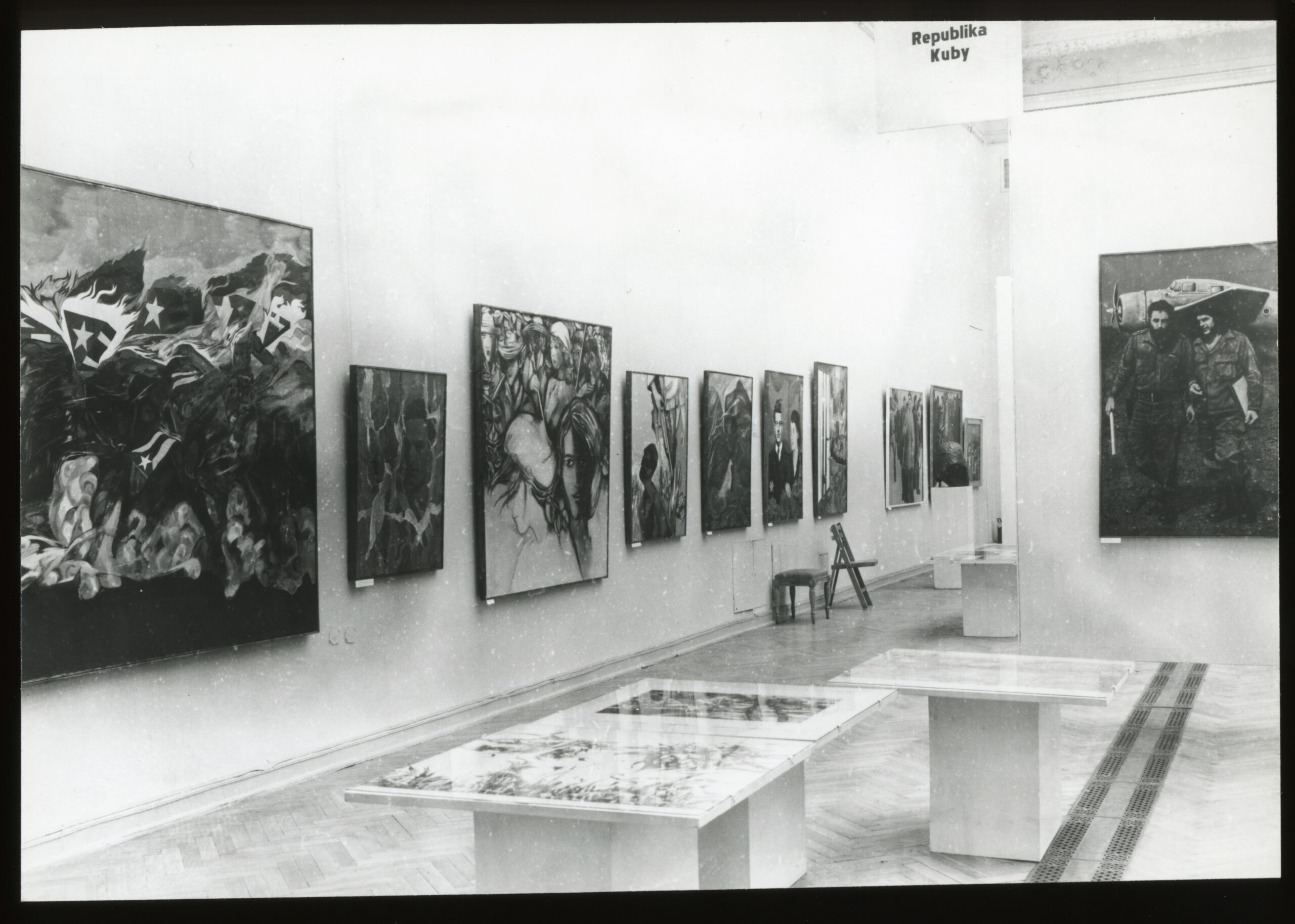
„Thirty Victorious Years. International Art Exhibition”, CBWA, Warsaw, 1977 [Cuban section]. Photo: Erazm Ciołek. Source: https://zacheta.art.pl/pl/wystawy/30-zwycieskich-lat-miedzynarodowa-wystawa-sztuki?galeria=1, CC BY-NC-ND 3.0
The Soviet side’s “urgent request” to the Polish Ministry of Culture and Art was granted. On 10 February 1977, representatives of the Department of Art and the CBWA met to discuss the organization of the exhibition at the Zachęta building. The CBWA was to send letters to all participating countries asking them to reduce their sections while still in Bucharest, before transport to Warsaw. It was decided that the retrospective section would be displayed in the three lower rooms, and the national sections in the upper rooms. The USSR was allocated a space over a dozen meters larger “due to the large volume of the exhibition.”63 The Department of Cultural Cooperation with Foreign Countries of the Ministry of Culture and Art was to assist the CBWA in organizing the travel and stay of foreign guests in Warsaw, and the Department of Art undertook to provide paper for printing the catalog and poster on an urgent basis.64 Four days later, on 14 February 1977, a meeting of the management and employees of the Zachęta was held, and the following note was made in the official memo: “On 27 January 1977, the CBWA was obliged to organize an exhibition at the Zachęta to mark the 30th anniversary [emphasis added – G.Ś.], which has already toured all the capitals of socialist countries and is now on its way from Romania to Poland.”65 It was planned to print 2,000 copies of the catalog (text section) in Warsaw, and a further 1,500 copies of the poster were to be produced in leaflet form and distributed to schools and workplaces. The arrival of the exhibition from Romania was scheduled for around 15 March, the delivery of the exhibits to the exhibition halls by 22 March, and the dismantling of the exhibition from 2 to 16 May.66
The exhibition, organized at top speed, opened at the Zachęta on 5 April 1977. The opening was preceded by a press conference (4 April) and a meeting of the International Organizing Committee for the Exhibition (5 April) in the Column Hall of the Primate’s Palace at Senatorska Street (since the exhibition in Moscow, meetings of the Organizing Committee had usually been held just before the opening of the exhibition in individual countries).67 On 2 and 3 April 1977, Mieczysław Ptaśnik welcomed foreign guests arriving in Warsaw at the airport and participated in the work of the commission “reviewing the exhibition” appointed by the deputy minister, who ultimately did not appear at Zachęta on Saturday morning. The director recalled: “We did the review ourselves.”68
Exhibition 30 Victorious Years in Havana and Ulaanbaatar, 1978–1979
The CBWA director’s diary contains an anecdotal account of a meeting of the International Organizing Committee for the Exhibition in Warsaw. This source is important for outlining the specific logistics of the exhibition, as it contains an unofficial description of the decision-making processes and details of the economic realities of the Eastern Bloc, for example information indicating that the ministries of finance allocated funds for transport from individual countries:
Among the conference participants was a representative from Mongolia who had a very poor understanding of Russian. There was a discussion about the future of the exhibition. It was proposed to transport it from Poland to Schönefeld Airport in Berlin (GDR), from where it was to fly to Cuba on a large Dutch plane chartered by the GDR. This plane was necessary because the painting, probably by Dejneka, did not fit into normal luggage compartments. The Germans even brought a representative of Interflug with them, who explained the technical details and deadlines with extraordinary German precision. The plane was to cost a huge sum in USD. From Cuba, the exhibition was to be moved to Mongolia! People began to wonder whether the climatic conditions there would be suitable at that time of year. […] As a result, when our two trucks (Hartwig) arrived at Berlin airport after the end of the Warsaw exhibition, it turned out that there was no plane, because the GDR Ministry of Finance, considering it absurd to rent a plane, did not provide the money. The exhibition lay in a warehouse for several months, waiting for sea transport, for which it was not prepared.69
An official letter from Mieczysław Ptaśnik to the Ministry of Culture and Art (29 December 1977) reveals that in June 1977, an employee of the CBWA handed over exhibits from the exhibition to a representative of the Zentrum für Kunstausstelungen DDR, which were transported to Rostock, from where they were to be delivered to Cuba by sea. However, as the director of the CBWA asked with concern, “We know from unofficial sources that the exhibition did not reach Cuba, […] we do not know the fate of the exhibits, especially the Polish section. We kindly ask for clarification regarding the current status of the exhibition and what information the CBWA should provide to the museums from which it borrowed the works of art.”70 In a letter dated 6 January 1978, the Department of Art of the Ministry of Culture and Art reassured the CBWA that the exhibits had already arrived in Cuba and that the opening was planned for the end of January or beginning of February.71
The opening at the National Museum in Havana finally took place on 8 March 1978, although not without organizational problems. Already in January 1978, the Embassy of the People’s Republic of Poland in Havana requested urgent delivery of catalog materials from Poland, as the GDR, responsible for transporting the exhibits to Cuba, had only provided materials for the catalog from its own country.72 The opening in Havana was attended by the commissioner of the Polish section, who wrote to the Department of Art of the Ministry of Culture and Art requesting that a conservation specialist be delegated to assist with the dismantling:
Although, at the meeting of the Exhibition Organizing Committee in Havana, the Cuban side undertook responsibility for packing the exhibits – with possible assistance from Soviet and Bulgarian conservators – having learned of the rather low level of responsibility demonstrated by the Havana exhibition organizers, I believe that the presence of a Polish expert during the packing process is essential. Let us remember that the exhibition still has a long journey ahead of it, by sea and rail, to Mongolia.73
In April 1978, representatives from Poland, Czechoslovakia, Hungary, East Germany, and the USSR arrived in Havana to dismantle the exhibition. Representatives from Bulgaria, Romania, Vietnam, and Mongolia did not arrive. According to an employee of the National Museum in Warsaw, who was delegated to dismantle the Polish section in Havana, Ulaanbaatar, as the next venue for the exhibition, did not provide either an assembly team or materials.74 According to this account, the exhibition was transported in containers on a Soviet ship to Leningrad, and then transported by land to Mongolia.75
Another report by a National Museum in Warsaw employee indicated that the exhibition arrived in Ulaanbaatar; it was dismantled on 3 December 1978, loaded onto wagons, and sent to Moscow. The USSR Ministry of Culture was to inform all countries of the date of collection of the crates from Moscow around 15 January 1979.76 However, in July, the CBWA sent letters to the “Warta” Insurance and Reinsurance Society and to the Railway Customs Office regarding the prolonged return of the works from the exhibition. At the same time, news came from the Department of Cultural Cooperation with Foreign Countries of the Ministry of Culture and Art that “the works were lost on their way from Mongolia to Moscow and the search for the wagons in which they were transported is currently underway.”77 It was not until November 1979 that the exhibits from the Polish section were collected from the All-Union Artistic Exhibitions Combine in Moscow by representatives of the CBWA and the National Museum and transported to Warsaw by road.78
In the first quarter of 1980, the CBWA was still engaged in the process of returning works borrowed in 1975, e.g., exhibits from the Museum of the History of the Polish Revolutionary Movement in Warsaw (including Teresa Żarnowerówna’s poster Na jedność robotniczo-chłopską głosuj! [Vote for the Unity of Workers and Peasants!] from a series prepared for the left-wing list for the 1928 Sejm elections).79 The history of the loan of the flagship work of Polish socialist realism, Andrzej Strumiłło’s painting Nasza ziemia [Our Land] (1954) – a composition referring to the resettlement to the Western and Northern Territories, presented at the 4th National Art Exhibition (CBWA, 1954) – is well documented. In March 1980, the Lubusz Land Museum sent a letter to the CBWA requesting the return of the painting:
The management of the Lubusz Land Museum in Zielona Góra, with reference to the letters […], would like to kindly ask once again when Andrzej Strumiłło’s work Nasza ziemia will be returned. This painting was loaned on 28 May 1975, for the exhibition 30 Victorious Years on the basis of a letter sent to us on 18 February 1975 […]. As the work was to be returned in the same year and, due to its subject matter, is an important element of our permanent exhibition of Polish painting, we have repeatedly inquired about the date of its return. Particularly concerned by your letter of 13 June 1979 […] regarding the re-loan of the painting for the exhibition of State Award Winners, we sent a letter on 22 June 1979 asking for clarification as to the current location of the painting and when it would be returned. Unfortunately, we have not received a reply, nor have we received a reply to our last letter of 8 February 1980, in which […] we asked again about Andrzej Strumiłło’s painting.80
As can be seen from the above document, the CBWA clearly forgot that Nasza ziemia had been touring the world with an exhibition since 1975.
“Art of the Socialist Era”
We already know that the number of works varied between 1975 and 1978 depending on the location of the exhibition. The largest number that can be found in the archival materials is the aforementioned 1,680 objects brought to Bucharest in 1977. The enormity of the undertaking is also evidenced by the two-volume catalog, which, however, does not contain a list of all the works presented in subsequent editions. The volume, printed in Moscow in 1975, which remained under the full control of the Soviet side from the outset, contains 209 illustrations, including 43 works from the retrospective section of the exhibition and a dozen works from each of the ten national sections. The volume with illustrations was to open with a two- or three-page introduction, agreed upon by the Organizing Committee.
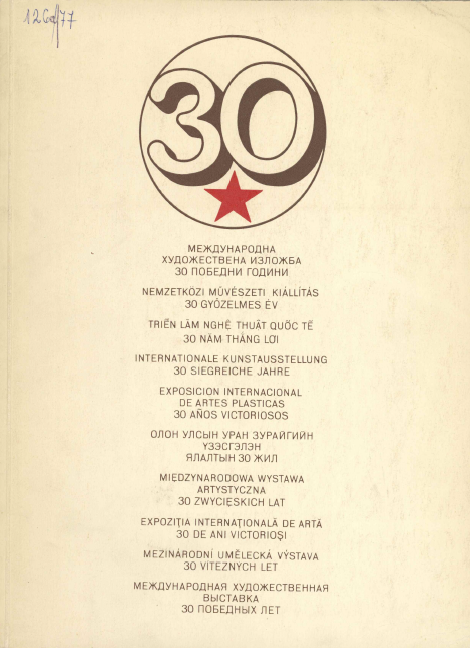
„Thirty Victorious Years. International Art Exhibition”, Moscow, 1975, exhibition catalogue [illustration section]. Source: https://zacheta.art.pl/pl/mediateka-i-publikacje/30-zwycieskich-lat-miedzynarodowa-wystawa-sztuki-ilustracje.
This introduction (not signed with the author’s or authors’ names) ultimately opens the second volume, with lists of works, printed in Polish in Warsaw in 1977. It refers to the thirty years that have passed “since the historic victory over German fascism”; it emphasizes that this victory was “the practical embodiment of the idea of Great October.”81 However, further fragments testify to the aforementioned change in the concept of the exhibition, i.e., the collection of works depicting the current “construction of socialism”:
The exhibition 30 Victorious Years is a review of the creative output of socialist countries. It presents the art of socialist realism [emphasis added – G. Ś.] and reflects our achievements in building a new society. […] The retrospective part of the exhibition brings together works created during the struggle against fascism. Even today, socialist art draws on this revolutionary source. […] The exhibition presents the art of the socialist era [emphasis added – G. Ś.], paving the way for a communist future.82
The second volume of the 30 Victorious Years catalog also includes a few sentences of general commentary on the retrospective section and lists of works (over a thousand exhibits) arranged alphabetically by country, according to the Polish alphabet: Bulgaria (the catalog gives the full names of countries, e.g., People’s Republic of Bulgaria), Czechoslovakia, Cuba, Mongolia, East Germany, Poland, Romania, Hungary, Vietnam, the USSR. As noted in the manner already familiar to us, the text section was printed in Poland in what was described as “flash” mode, hence the annotation that the catalog “contains updated lists of works from Czechoslovakia, the German Democratic Republic, and Poland. Since no lists of exhibits were sent from other countries during the editing of the catalog, it was based on the lists of works exhibited in Sofia.”83
In each country, the exhibition looked slightly different; it was subject to constant “reductions” or “additions” depending on the specifics of the exhibition space. Another issue is the actual size of the audience and its interest in anniversary exhibitions of contemporary art, whether at the Altes Museum, the pavilion in Budapest, or the CBWA, whose official program was contested, for example, by the Foksal Gallery circle. We “avoided the Zachęta with distaste,” as Andrzej Turowski recalls his strolls with Krzysztof Wodiczko in Warsaw in the early 1970s.84 At the Zachęta, part of the audience usually boycotted the so-called anniversary exhibitions (even before the complete boycott of the gallery began during martial law), e.g. the exhibition of works by members of the USSR Academy of Arts, opened in April 1975, organized as part of the Days of Soviet Culture in Poland, referring to the anniversary of the signing of the Treaty of Friendship, Cooperation, and Mutual Assistance between Poland and the USSR and the anniversary of the victory over fascism. As it was cautiously stated in ministerial reports: “It must be said that this exhibition was not successful in Warsaw.”85
However, the illustrative material from 30 Victorious Years, contained in a volume printed in Moscow, constitutes a lasting – unlike the ephemeral traveling exhibition – testimony to the political construction of the “canon” of socialist art in the 1970s. The illustrated volume functioned as a kind of universal album of socialist contemporary art.86 It contained no list of works and no commentary; however, it also did not need to be translated into several languages and alphabets. It traveled with the changing exhibition as its permanent, propagandistic, carefully selected, and censored visual supplement, curated in Moscow itself.
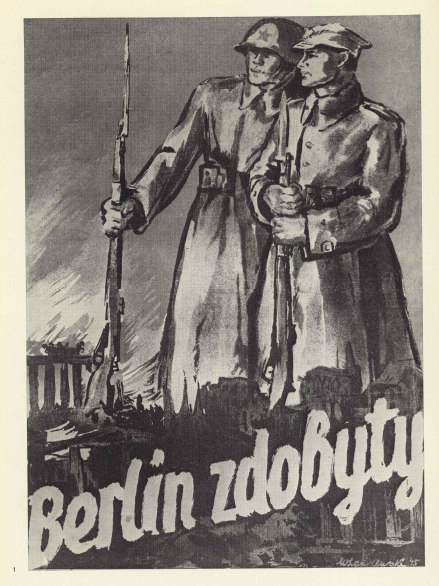
Włodzimierz Zakrzewski, „Berlin Captured”, 1945. „Thirty Victorious Years. International Art Exhibition”, Moscow, 1975, exhibition catalogue [illustration section, no. 1]. Source: https://zacheta.art.pl/pl/mediateka-i-publikacje/30-zwycieskich-lat-miedzynarodowa-wystawa-sztuki-ilustracje.
The retrospective section of the volume with illustrations opens with reproductions of Polish posters, such as Włodzimierz Zakrzewski’s Berlin zdobyty [Berlin Conquered] (1945), Tadeusz Trepkowski’s Chwała wyzwolicielom! [Glory to the Liberators!] (1946), Xawery Dunikowski’s paintings Droga do wolności [The Road to Freedom] (1955) and Orkiestra [Orchestra] (1953) from the Oświęcim [Auschwitz] series, and Bronisław Wojciech Linke’s Luftwaffe (1948) from the Kamienie krzyczą [Screaming Stones] series. Most of the works from other countries reproduced in this section were already known in the People’s Republic of Poland from numerous exhibitions organized after World War II under bilateral agreements. These include works by artists from the USSR (e.g., the Kukryniksy, Sergei Gerasimov, Alexandr Deineka), artists from East Germany (Otto Nagel, Hans Grundig, Käthe Kollwitz, Herbert Sandberg, John Heartfield) and, for example, paintings by Josef Čapek from the series Oheň [Fire] (1938) from the collection of the National Gallery in Prague.
The retrospective section of the exhibition 30 Victorious Years can therefore be seen today as a top-down attempt to establish a canon of works from socialist countries, in accordance with the “founding myth” of the Eastern Bloc, namely the “joint” victory over fascism.87 In the aforementioned internal report from the delegation to the opening of the exhibition in Moscow in 1975, the director of the Department of Art at the Ministry of Culture and Art expressed his surprise that some national sections were particularly keen to celebrate the “fight against fascism,” even though the main idea of the exhibition was to present “socialist construction.” As he reported:
[…] only the sections of the USSR, Mongolia, Vietnam, and Poland can be considered consistent with the idea of the exhibition. The others, especially those of Hungary, East Germany, Bulgaria, and Czechoslovakia, were 90% about the fight against fascism (!?), martyrdom, etc. The overload of these displays with paintings and sculptures was probably intended to show the uninformed viewer the contribution of these countries to the victory over fascism.88
The facts were thus not forgotten – for example, that the post-war Eastern European bloc also included countries that had joined the Axis powers during World War II (Hungary, Romania, Bulgaria, Slovakia). But it was precisely for this reason that post-war socialist realism art was dominated by images of partisans fighting against fascist regimes during the war.
The national sections of the catalog reproduce a selection of works created between 1945 and 1975. Polish art is represented by early works, such as the aforementioned Górnik Wincenty Pstrowski [Miner Wincenty Pstrowski] (1948) by Felicjan Szczęsny Kowarski and Ziemia chłopom [Land to the Peasants] (1952) by Juliusz Krajewski, but also later works, such as Chemostal I (1966) by Benon Liberski and Uskrzydlona Warszawa [Winged Warsaw] (1964) by Gustaw Zemła. It is worth mentioning that the works of many artists from the national sections had previously been shown at exhibitions at the CBWA, e.g. at the International Exhibition of Young Art organized as part of the 5th World Festival of Youth and Students (1955) or at the exhibition of seven European socialist countries Against War and Fascism (1970). The Hungarian section featured, for example, the iconic work of Hungarian socialist realism, Martinász [Steelworker] (1953) by József Somogyi, which had previously won an award at the 1955 festival exhibition. Agamemnon Makrisz was a guest at the 5th World Festival in Warsaw, and his design for the monument in Mauthausen was shown at the CBWA in 1970. In the exhibition catalog, in the East German section, one can find the names of leading artists whose works had already been shown at the CBWA in individual exhibitions: at the international exhibition in 1955 (e.g., Bert Heller) and in 1970 at the exhibition Against War and Fascism (e.g., Willi Sitte). Paintings by Romanian painter Corneliu Baba were presented at the CBWA, for example, in 1955. The works of Servando Cabrera Moreno, included in the Cuban section, visited Warsaw with the first post-Cuban Revolution painting exhibition as early as 1962.89 The reasons for the frequency with which art from the USSR was exhibited in the People’s Republic of Poland do not need to be explained.90 However, what should be noted is that such frequency of presentation and reproduction of works influenced the consolidation and updating of the canon. Suffice it to mention the painting that has been exhibited in Warsaw several times. Reproduced on Belarusian postage stamps, Mikhail Savitsky’s Partyzánskaya Madónna [Partisan Madonna] (1967) was shown at the 6thExhibition of Realist Painters (CBWA, 1968), then at the exhibition Against War and Fascism (CBWA, 1970) – and returned to Warsaw again in 1977.
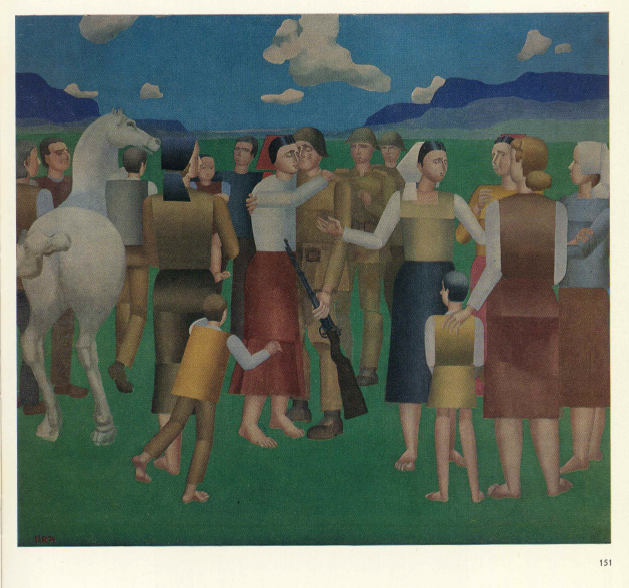
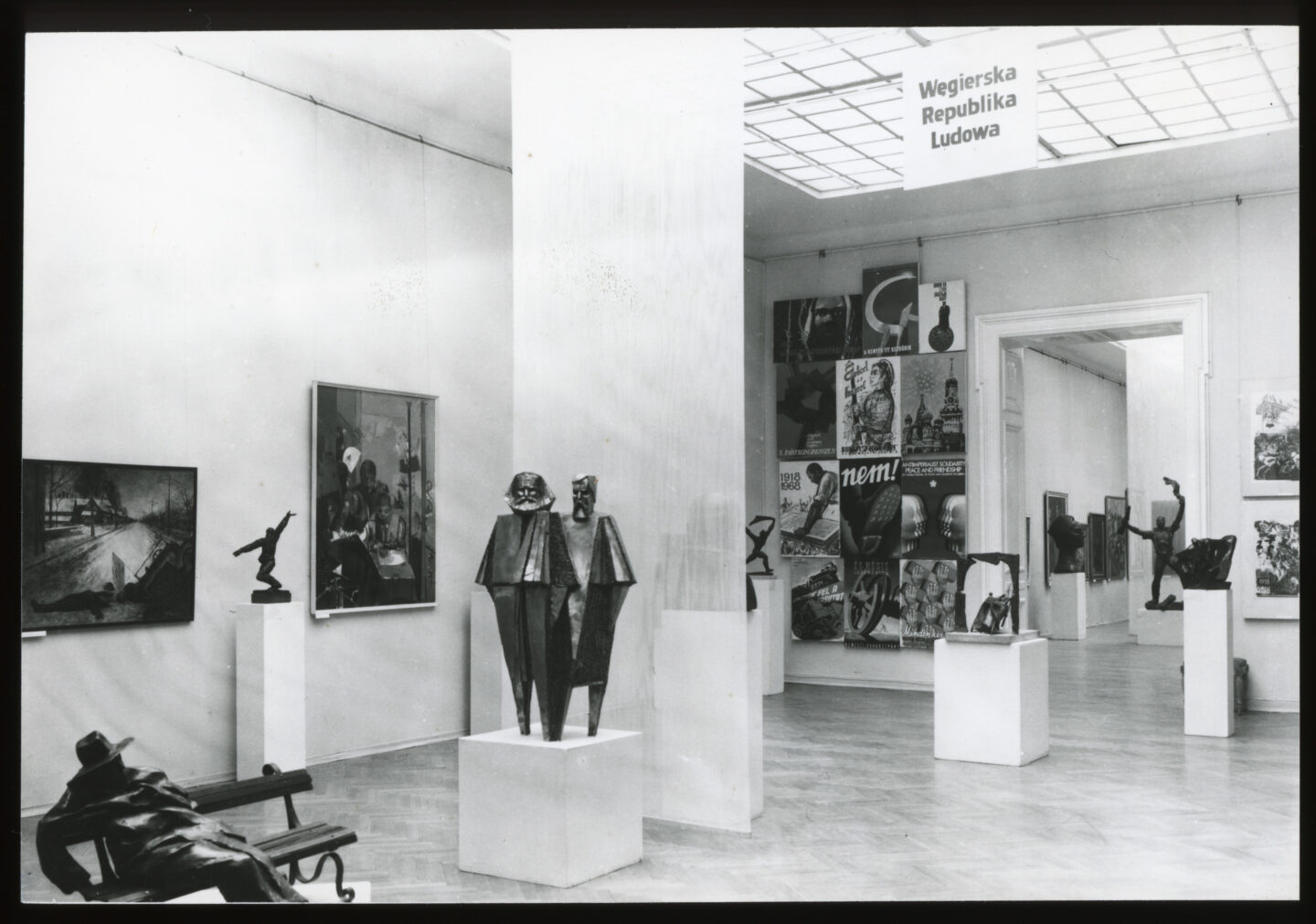
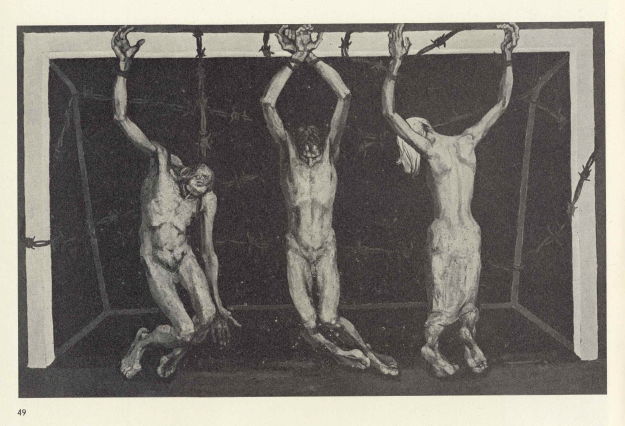
The above examples show that the political goal of the exhibition 30 Victorious Years was to establish (socialist) realism as an international “style” and thus promote the idea of socialist internationalism. New works from the 1970s were added to this canon of post-Stalinist socialist realism, such as Mihai Rusu’s painting Powrót rumuńskich bohaterów z wojny przeciwko faszystom [The Return of Romanian Heroes from the War Against Fascism] (1974) and György Segesdi’s “cubist” sculpture Marx and Engels (1975). It was also important to update political iconography, which included not only monumentalized images of revolutionary leaders or victorious battles and guerrilla warfare, but also depictions of the cruelty of wars and events from recent world political history. An example is Svetlin Rusev’s painting Santiago de Chile Stadium (1974), reproduced in the Bulgarian section of the catalog. The depiction of naked bodies tied with barbed wire to the goalposts on a football field is probably a reference to the coup in Chile in 1973, when the National Stadium in the capital was turned into a concentration camp (although this explanation is not found in the catalog).
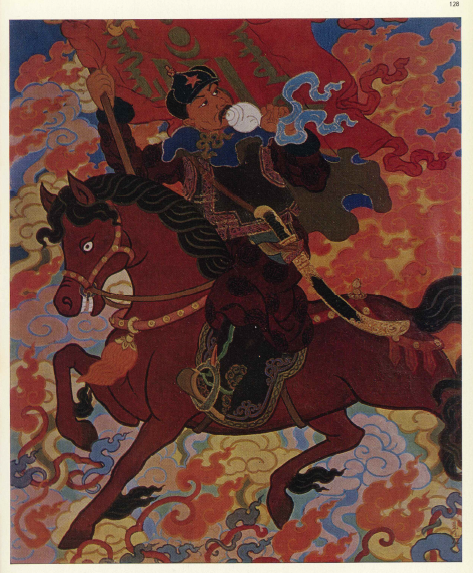
The exhibition also included works that reinterpreted the principle of “socialist in content, national in form” in a surprising way (at least for Europeans). In his painting Appeal (1972, National Gallery of Modern Art, Ulaanbaatar), Mongolian artist Nyam-Osor Tsultem depicted a horseman with a red star blowing a horn, calling for battle. However, the form refers to the decorativeness of Buddhist “flat paintings” (thangka).91 As already mentioned, the catalog did not contain analyses of individual works. Meanwhile, Appeal is a painting reminiscent in form of the Buddhist culture that dominated Mongolia until the 1920s, i.e., until the beginning of Sovietization.
The exhibition received enormous coverage in the Polish press, as it was promoted from the top down.92 In addition to the commissioners of the national sections, the ministries of culture appointed so-called organizational directors of the exhibition in all participating countries. Their task was to supervise the assembly and dismantling, but above all, they were responsible for “proper propaganda,” i.e., cooperation with the media and guiding official guests around the exhibition.93 The CBWA received about thirty reviews from earlier openings, published in the USSR, East Germany, and Romania. In Warsaw, a press commissioner for the exhibition was appointed from the editorial office of Trybuna Ludu, the press organ of the Central Committee of the Polish United Workers’ Party.94 In the Polish press, not only in Trybuna Ludu, but also in Gromada – Rolnik Polski and Tygodnik Kulturalny, notes about the exhibition appeared as early as February and March 1975, when its opening in Moscow was announced. They listed the composition of the Polish section and counted the number of viewings in successive capitals of socialist countries. In April 1976, Trybuna Ludu and Życie Warszawy published information about the opening in Prague.
The exhibition at Warsaw’s Zachęta gallery was announced before its opening on the front page of Express Wieczorny as a major international show of around five hundred works, whose “guiding principle is the fight against fascism and peaceful socialist construction.”95 The newspeak characterizing most of the press notes and reviews published in national and regional periodicals, which reproduced expressions and information from the ministerial documents cited above, is not the subject of the reflections presented here, although it deserves a separate study as an example of official, censored message. It also reveals aspects that are important for defining the internationalist assumptions of the exhibition, which showed “not only the achievements of realist art, but also the ideological unity of our countries.”96 The opening in Warsaw was described in Sztandar Młodych as follows: “the exhibits speak a language that is understandable to people in every corner of the globe,” but at the same time, the Mongolian section was commented on in vague terms: “the influence of Oriental miniatures is easily noticeable in the paintings from this distant country.”97 Reviewers noted the “different style” of the three non-European sections, but limited themselves to vague statements that “echoes of the great creativity of the peoples of Asia are revealed in the works of Mongolian painters, strongly connected with their native customs […]. Local artists make extensive use of traditional techniques.”98
The retrospective section included more in-depth commentary on “flagship” works which, as Jerzy Madeyski wrote in Życie Literackie, “once circulated throughout the press and book publishing houses, and were studied at universities.” He listed: “Who does not know Deineka’s Defense of Sevastopol (1942), Gerasimov’s Partisan’s Mother(1943), Heartfield’s photomontages […], the characteristic drawings of the Kukryniksy, or the designs […] of our avant-garde from the early 1920s?”99 If we accept the argument that the frequency and scope of reproduction of works of art translates into the consolidation and updating of the canon, then we should pay attention to the numerous reproductions of works from the exhibition in Warsaw, although paintings by the Polish avant-garde from the interwar period were not reproduced in the press on this occasion. The colorful spreads accompanying the reviews were published in 1977 in Zwierciadło, Kobieta i Życie (popular women’s magazines in communist Poland), Stolica, Żołnierz Polski, and Perspektywy. In the latter, an illustrated political and news weekly, Juliusz Krajewski’s socialist realist composition Ziemia chłopom [Land to the Peasants] (1952) is accompanied by a painting from the East German section – Der tote Präsident—Dr. S. Allende [Assassinated President (Dr. Salvador Allende)] from 1974, by Christoph Wetzl, a graduate of the Academy of Fine Arts in Dresden – and a portrait of Che Guevara (1975) by Cuban artist Orlando Yanes, aptly illustrating the reviewer’s remark that “Cuban art reveals strong links with American painting and graphic art, but the subject matter is closely related to the life and past of the country.”100
Conclusion
A brief overview of the catalog and press reviews clearly shows that a contemporary analysis of the internationalist, global ambitions of the exhibition 30 Victorious Years requires international cooperation between art historians who, from their local cultural perspectives, are able to evaluate and interpret works that appear to varying degrees in the art history textbooks of individual countries. The reflections presented in this article necessarily focus mainly on Polish archives and Polish historiography of art created since World War II. An analysis of logistical problems also shows that it was not only the exhibition itself and the art presented there, but also the eight-year process of organization – regular international conferences of ministers, committee meetings, pressure on representatives of Romania, Cuba, Mongolia, and Vietnam who were absent from the meetings, huge transportation costs, changes in the route and number of venues, assembly and disassembly, loans and returns, “lost” wagons with exhibits, etc. – were an attempt to mark political control in the Eastern Bloc. Many people and institutions from ten countries were involved in organizing the travel of a single exhibition for several years.
Polish archival sources do not indicate that the selection of works was criticized by the Soviet authorities (as was the case with the Polish section at the International Exhibition of Art of Socialist Countries in 1958, mentioned in the introduction). As we recall from Konstanty Węgrzyn’s report on his trip to the opening of the exhibition at the Manege in 1975, only Jerzy Nowosielski’s painting caused concern. It was not removed from the exhibition, but it was also not included in the illustrative part of the catalog, which was prepared from submitted materials, censored, and printed in Moscow. It should also be remembered that before each opening, the exhibition was “reviewed” by representatives of the Organizing Committee or ministerial authorities. It can therefore be concluded that the international exhibition of socialist countries’ art, which traveled in the 1970s and was controlled from above at successive stages of its organization, reflected the global, post-war ambitions of Soviet cultural policy, already manifested at the 1958 exhibition.
The 1958 International Exhibition of Art of the Socialist Countries was presented at the Manege in Moscow, i.e. the Central Exhibition Hall, which hosted, for example, large Soviet all-Union exhibitions.101 The Manege was also the venue for the first and largest version of 30 Victorious Years exhibition, which was intended to celebrate the 30thanniversary of the end of World War II and the “victory over fascism.” From Moscow, as the “center” of the Eastern Bloc, the works set off on a further journey. The general concepts of both international exhibitions were developed at ministerial meetings: the assumptions of the 1958 exhibition – at a meeting of representatives of the Ministries of Culture and artistic institutions of socialist countries, and the main ideas of the traveling exhibition 30 Victorious Years were developed, as described, at the 5th Conference of Ministers of Culture of Socialist Countries in Havana and at subsequent conferences and meetings of international organizing committees. Both exhibitions consisted of national sections and an introductory section, bringing together works from all the socialist countries participating in the project.
The general concepts and strategies of the organization were therefore similar, but the two official exhibitions differed in terms of the lists of participating countries, reflecting the geopolitical changes that had taken place since the late 1950s. Twelve countries took part in the 1958 Moscow exhibition: eight from Europe (Albania, Bulgaria, Czechoslovakia, East Germany, Poland, Romania, Hungary, and the USSR) and four from Asia (China, North Korea, Mongolia, and Vietnam).102 Ten countries ultimately took part in the traveling exhibition 30 Victorious Years: seven from Europe (Bulgaria, Czechoslovakia, East Germany, Poland, Romania, Hungary, and the USSR) and three from other continents (Cuba, Mongolia, and Vietnam). The absence of art from China should be interpreted as a result of the Sino-Soviet split in 1960, which also affected cultural relations. Political differences within the Eastern Bloc in the 1960s and early 1970s also explain the absence of sections from Albania and North Korea.103 In turn, the presence of Cuban art at the exhibition 30 Victorious Years was a result of the 1959 revolution and the progressive Sovietization of Cuban culture.104 Regardless of these geopolitical differences, however, the core of both exhibitions remained the sections devoted to the USSR and European socialist countries.105
The 1958 exhibition is seen as the USSR’s response to the post-war policy of the Venice Biennale, when the presentation of realistic art in the Soviet pavilion in 1956 was critically assessed against the backdrop of contemporary “Western” abstraction and pop art.106 The exhibition 30 Victorious Years traveled during a period of increasing global “biennialization” – a process that included the organization of the São Paulo Biennial (since 1951), the New Delhi Triennial (since 1968), and the first Arab Art Biennial in Baghdad (1974).107 In the era of Cold War biennialization (understood as cultural decentralization), global decolonization processes, and the emancipation of the “Third World” from the binary division into capitalist and communist blocs, the exhibition 30 Victorious Years would be an attempt to reconsolidate and update the “canon” of Eastern Bloc realist art and maintain Soviet control over it.
The reflections presented here do not exhaust the issue of “anniversary” exhibitions in the history of the Eastern Bloc, organized, for example, on the occasion of Lenin’s 100th birthday (1970), the anniversaries of the October Revolution, the end of World War II as a celebration of the joint “victory over fascism” of the post-war socialist countries, or the anniversaries of the signing of treaties of friendship, cooperation, and mutual assistance between nations, in accordance with the principles of socialist internationalism.108 However, they can serve as a starting point for further research and revision of the artistic canons formed in the Eastern Bloc. If we consider the exhibition 30 Victorious Yearsto be an example of socialist “central planning” of the canon – which in fact encompassed the art of Europe, Asia, and Latin America – it should also be emphasized that it was directed against “modern,” “alternative,” or “dissident” art. When the exhibition was sent from East Germany to Cuba, Venice hosted the so-called Biennale of Dissident Culture from 15 October to 17 November 1977, consisting of three exhibitions devoted to film, literature, and visual arts, presenting the phenomenon of unofficial culture in the USSR and other Eastern Bloc countries on an international forum.109 A completely different vision of art was developed in parallel at the Conferences of Ministers of Culture of Socialist Countries in the 1970s, which were attended not only by European countries, but also by representatives of Cuba, Mongolia, and Vietnam. During these conferences, solidarity was expressed, for example, with “the cause of the Vietnamese people” building a “new culture” after the end of a devastating 20-year war in 1975, while at the same time emphasizing “the superiority of socialist art and culture.”110
Bibliography
30 zwycięskich lat. Międzynarodowa wystawa sztuki, katalog wystawy [część tekstowa], Centralne Biuro Wystaw Artystycznych, Warszawa 1977.
Alsaden, A., Baghdad’s Arab Biennial: Regional Subversions, Global Ambitions, „Third Text” 2018, nr 33, s. 1–30.
Alternative Globalisations: Eastern Europe and the Postcolonial World, red. J. Mark, A. Kalinovsky, S. Marung, Indiana University Press, Bloomington 2020.
Bazin, J., Dubourg Glatigny, P., and Piotrowski, P., Introduction: Geography of Internationalism, w: Art Beyond Borders: Artistic Exchange in Communist Europe (1945–1989), red. J. Bazin, P. Dubourg Glatigny, P. Piotrowski, Central European University Press, Budapest, New York 2016, s. 1–28.
Bertelé, M., The Exhibition of Socialist Countries: Central Exhibition Hall, Moscow, December 1958 – Spring 1959, w: Curating Socialism: A Handbook of International Art Exhibitions 1947–1989, red. S. Spieker, P. Savage, B. Videkanić and C. d’Anca, University of Toronto Press, Toronto 2026 [w druku, https://utpdistribution.com/9781487552992/curating-socialism, dostęp: 28 grudnia 2025].
Bories, E., The Influence of Käthe Kollwitz on Chinese Creation: Between Expressionism and Revolutionary Realism, w: Art Beyond Borders: Artistic Exchange in Communist Europe (1945–1989), red. J. Bazin, P. Dubourg Glatigny, P. Piotrowski, Central European University Press, Budapest, New York 2016, s. 453–460.
Camnitzer, L., New Art of Cuba: Revised Edition, University of Texas Press, Austin 2003.
Circulations in the Global History of Art, red. T. DaCosta Kaufmann, C. Dossin, B. Joyeux-Prunel, Routledge, London, New York 2017.
Elkins, J., The End of Diversity in Art Historical Writing: North Atlantic Art History and Its Alternatives, De Gryuter, Berlin, Boston 2021.
(es), „30 zwycięskich lat”, „Sztandar Młodych” 1977 (6 kwietnia), nr 81, s. 4.
Gavrash, I., Ekspozycja polska na Międzynarodowej Wystawie Sztuki Krajów Socjalistycznych w byłym Maneżu w Moskwie w 1958/1959, w: Sztuka Europy Wschodniej: Polska – Rosja: Sztuka i historia, t. 2., Sztuka polska, sztuka rosyjska i polsko-rosyjskie kontakty artystyczne XX–XXI wieku, red. J. Malinowski, I. Gavrash, Z. Krasnopolska-Wesner, Polski Instytut Studiów nad Sztuką Świata, Warszawa 2014, s. 437–443.
Green, C., Gardner, A., Biennials, Triennials, and documenta: The Exhibitions that Created Conteporary Art, Wiley Blackwell, Chichester 2016.
Grenier, Y., Culture and the Cuban State: Participation, Recognition, and Dissonance under Communism, Lexington Books, Lanham 2017.
(grt), Wielka wystawa krajów socjalistycznych „30 zwycięskich lat”, „Express Wieczorny” 1977 (29 marca), nr 71, s. 1 i 2.
Heyman, Ł., Stuka walcząca, „Zwierciadło” 1977 (5 maja), nr 18, s. 16–17.
Ho, C. I., People’s Republic of China Section, Art Exhibition of Socialist Countries: Central Exhibition Hall, Moscow, December 1958 – Spring 1959, w: Curating Socialism: A Handbook of International Art Exhibitions 1947–1989, red. S. Spieker, P. Savage, B. Videkanić and C. d’Anca, University of Toronto Press, Toronto 2026 [w druku,https://utpdistribution.com/9781487552992/curating-socialism, dostęp: 28 grudnia 2025].
Isto, R., Between Two Easts: Picturing a Global Socialism in Abanian Post-War Art, 1959–69, „Art History”, 45 (5), November 2022, Red Networks: Postwar Art Exchange, red. V. Li, s. 1059–1077.
Kempe, A., Dmitrieva, M, Introduction: Global or Universal? Reconsidering Socialist Art Histories, w: Universal – International – Global: Art Historiographies of Socialist Eastern Europe, red. A. Kempe, B. Hock, M. Dmitrieva, Böhlau Verlag, Wien, Köln 2023, s. 9–32.
Kucharska, P., Kłopotliwy gość. Polska ekspozycja na międzynarodowej wystawie w Moskwie (1958/1959), 30.06.2005,https://culture.pl/pl/artykul/klopotliwy-gosc-polska-ekspozycja-na-miedzynarodowej-wystawie-w-moskwie-19581959[dostęp: 28 grudnia 2025].
La nuova arte sovietica: una prospettiva non ufficiale. ZKK: Rereading, Die Dissens-Biennale 1977 in Venedig, red. M. Bertelé, S. Frimmel, Edition Schublade, Zürich 2014.
Lee, S., Out of Sync in Havana: Two Socialist Visions of Global Contemporary Art, „Art History”, 45 (5), November 2022, Red Networks: Postwar Art Exchange, red. V. Li, s. 1103–1125.
Li, V., Introduction: Making Rooms for Misfits, „Art History”, 45 (5), November 2022, Red Networks: Postwar Art Exchange, red. V. Li, s. 935–951.
Madeyski, J., Trzydzieści zwycięskich lat, „Życie Literackie” 1977 (1 maja), nr 18, s. 3.
Marynowska, E., Sztuka jako dokument epoki, „Perspektywy” 1977 (29 kwietnia), nr 17, s. 10–13.
(m. g.), 30 zwycięskich lat, „Głos Robotniczy” 1977 (5 kwietnia), nr 76, s. 1 i 2.
Morganová, P., Podoby oficiálni kultury, w: České umění 1939–1999. Programy a impulzy, red. J. Kovandová, D. Dušková, Vědecko-výzkumné pracoviště, Akademie výtvarných umění v Praze, Praha 2000, s. 36–43.
Orišková, M., Shifts and Gaps in the Paradigm of Socialist Internationalism: Czechoslovak Exhibitions Abroad, 1956–1988, w: Universal – International – Global: Art Historiographies of Socialist Eastern Europe, red. A. Kempe, B. Hock, M. Dmitrieva, Böhlau Verlag, Wien, Köln 2023, s. 77–97.
Piotrowski, P., Globalne ujęcie sztuki Europy Wschodniej, Rebis, Poznań 2018.
Reid, S. E., The Exhibition Art of Socialist Countries, Moscow 1958–9, and the Contemporary Style of Painting, w: Style and Socialism: Modernity and Material Culture in Post-War Eastern Europe, red. S. Reid, D. Crowley, Berg, Oxford 2000, s. 101–132.
Socialism Goes Global: The Soviet Union and Eastern Europe in the Age of Decolonisation, red. J. Mark, P. Betts, Oxford University Press, Oxford, New York 2022.
Starzyński, J., Artyści polscy na Międzynarodowej Wystawie Sztuki Krajów Socjalistycznych w Moskwie, w:Międzynarodowa Wystawa Sztuki Krajów Socjalistycznych. Wystawa artystów polskich. Malarstwo – rzeźba – grafika. Moskwa 1958, red. H. Stępień, Wojskowe Zakłady Graficzne w Warszawie, Warszawa 1958, s. 7–32.
Szczerski, A., Global Socialist Realism: The Representation of Non-European Cultures in Polish Art of the 1950s, w: Art Beyond Borders: Artistic Exchange in Communist Europe (1945–1989), red. J. Bazin, P. Dubourg Glatigny, P. Piotrowski, Central European University Press, Budapest, New York 2016, s. 439–452.
Świtek, G., „Długie trwanie” sztuki radzieckiej w PRL, w: Kultura miejsca. Studia ofiarowane Profesorowi Wojciechowi Włodarczykowi, red. W. Baraniewski, P. Słodkowski, Akademia Sztuk Pięknych w Warszawie, Warszawa 2019, s. 226–237.
Świtek, G., „Jak Fidel na wiecu w Hawanie”. Warszawska wystawa malarstwa kubańskiego z globalnym kryzysem politycznym w tle (1962), „Miejsce” 2019, nr 5, https://miejsce.asp.waw.pl/jak-fidel-na-wiecu-w-hawanie/ [dostęp: 28 grudnia 2025].
Tsultemin, U., Contemporary Art of Mongolia in the Era of Globalisation, „Asia Pacific Art Papers”,https://apap.qagoma.qld.gov.au/contemporary-art-of-mongolia-in-the-era-of-globalisation/ [dostęp: 14 lipca 2025].
Turowski, A., Dziura w całym. O sztuce i historii sztuki współczesnej, Instytut Wydawniczy Książka i Prasa, Warszawa 2023.
Turowski, A., Notatki o awangardzie rosyjskiej w Polsce, w: Warszawa – Moskwa / Moskwa – Warszawa, 1900–2000, red. M. Poprzęcka, L. Jowlewa, Zachęta Narodowa Galeria Sztuki, Warszawa 2004, s. 50–58.
Was Socialist Realism Global? Modernism, Soc-modernism, Socially Engaged Figuration, red. M. Lipska, P. Słodkowski, Museum of Modern Art in Warsaw, Warsaw 2023.
Wasiak, P. Kontakty między artystami wizualnymi z Polski, Węgier, Czechosłowacji i NRD w latach 1970–1989, Instytut Pamięci Narodowej, Warszawa 2019.
Włodarczyk, W., Socrealistyczny epizod. Warszawa 1933 – Moskwa 1958, w: Warszawa – Moskwa / Moskwa – Warszawa, 1900–2000, red. M. Poprzęcka, L. Jowlewa, Zachęta Narodowa Galeria Sztuki, Warszawa 2004, s. 63–69.
- Dział Dokumentacji, Zachęta – Narodowa Galeria Sztuki [Documentation Department, Zachęta – National Gallery of Art, hereinafter: DD ZNGS], Warsaw, diary of Mieczysław Ptaśnik, 31 March – 3 April 1977, 13–14. ↩︎
- I discussed some of the sources related to the exhibition 30 Victorious Years in my paper A Better Tomorrow: Exhibitions of Socialist Countries during the Cold War, at the 10th Dłużew Seminar, entitled Tomorrow (House of the Academy of Fine Arts in Warsaw, Dłużew, 14–16 February 2025), organized by the Faculty of Artistic Research and Curatorial Studies of the Academy of Fine Arts in Warsaw. They complemented research on the exhibition Against War and Fascism (CBWA, 1970), which brought together works from seven socialist countries: Bulgaria, Czechoslovakia, East Germany, Poland, Romania, Hungary, and the USSR. Even then, there were mentions in the Polish press of plans to organize annual exhibitions on a similar theme in the Eastern Bloc. See G. Świtek, Socialist Images of War: The 1970 Exhibition of the Warsaw Pact Countries [in print]. ↩︎
- Patryk Wasiak, Kontakty między artystami wizualnymi z Polski, Węgier, Czechosłowacji i NRD w latach 1970–1989 [Contacts between Visual Artists from Poland, Hungary, Czechoslovakia, and the GDR in 1970–1989] (Warsaw: Instytut Pamięci Narodowej, 2019), 89–90, 140. ↩︎
- See an expression by Andrzej Turowski, in: idem, “Notatki o awangardzie rosyjskiej w Polsce” [Notes on the Russian Avant-Garde in Poland], in: Warszawa – Moskwa / Moskwa – Warszawa, 1900–2000, ed. Maria Poprzęcka and Lidia Jowlewa (Warsaw: Zachęta – Narodowa Galeria Sztuki, 2004), 53. For the 1958 exhibition in Moscow, see also: Wojciech Włodarczyk, “Socrealistyczny epizod. Warszawa 1933 – Moskwa 1958” [The Socialist Realist Episode. Warsaw 1933 – Moscow 1958], in: Warszawa – Moskwa / Moskwa – Warszawa, 1900–2000, op. cit., 63–69; Paulina Kucharska, Kłopotliwy gość. Polska ekspozycja na międzynarodowej wystawie w Moskwie (1958/1959) [An Awkward Guest. The Polish Exhibition at the International Exhibition in Moscow (1958/1959)], 30 June 2005, https://culture.pl/pl/artykul/klopotliwy-gosc-polska-ekspozycja-na-miedzynarodowej-wystawie-w-moskwie-19581959 (accessed 28 December 2025); Susan E. Reid, “The Exhibition Art of Socialist Countries, Moscow 1958–9, and the Contemporary Style of Painting,” in: Style and Socialism: Modernity and Material Culture in Post-War Eastern Europe, ed. Susan E. Reid and David Crowley (Oxford: Berg, 2000), 101–132. This exhibition is still the subject of art-historical analysis, as evidenced by the following articles: Matteo Bertelé, “The Exhibition of Socialist Countries: Central Exhibition Hall, Moscow, December 1958–Spring 1959,” in: Curating Socialism: A Handbook of International Art Exhibitions 1947–1989, ed. Sven Spieker, Polly Savage, Bojana Videkanić and Christene d’Anca (Toronto: University of Toronto Press, 2026), in print; Christine I. Ho, “People’s Republic of China Section, Art Exhibition of Socialist Countries: Central Exhibition Hall, Moscow, December 1958–Spring 1959,” in: ibid. ↩︎
- Approximately one quarter of the Polish section (52 works) consisted of sculptures and paintings by Xawery Dunikowski (e.g., Głowa żołnierza radzieckiego z Pomnika Wyzwolenia w Olsztynie [Head of a Soviet Soldier from the Liberation Monument in Olsztyn], 1949–1953). Another large group consisted of drawings by Tadeusz Kulisiewicz (e.g., from the series Warszawa 1945 from 1945–1946). Some works, such as Stanisław Horno-Popławski’s sculpture Matka Belojanisa [Beloyannis’s Mother] (1953), were shown and awarded prizes at the National Art Exhibitions in Warsaw. The group that sparked controversy in Moscow included works by Adam Marczyński (Wiosna [Spring], 1956) and Wacław Taranczewski (Martwa natura z wazonem III [Still Life with a Vase III], 1955–1956), described by the curator of the Polish section, Juliusz Starzyński, as “close to abstraction.” See Juliusz Starzyński, “Artyści polscy na Międzynarodowej Wystawie Sztuki Krajów Socjalistycznych w Moskwie” [Polish Artists at the International Exhibition of Art of Socialist Countries in Moscow], in: Międzynarodowa Wystawa Sztuki Krajów Socjalistycznych. Wystawa artystów polskich. Malarstwo – rzeźba – grafika. Moskwa 1958 [International Exhibition of Art of Socialist Countries. Exhibition of Polish Artists. Painting – Sculpture – Graphics. Moscow 1958], ed. Halina Stępień (Warsaw: Wojskowe Zakłady Graficzne, 1958), 22. ↩︎
- See 30 zwycięskich lat. Międzynarodowa wystawa sztuki [30 Victorious Years. International Art Exhibition], exh. cat. (text section) (Warsaw: Centralne Biuro Wystaw Artystycznych, 1977), n.p. [p. 3]. ↩︎
- See Vivian Li, “Introduction: Making Rooms for Misfits,” Art History 45, no. 5 (2022): 936–37. On circulation in art-historical research as a revision of the “static” concept of art geography, see Circulations in the Global History of Art, ed. Thomas DaCosta Kaufmann, Catherine Dossin, and Beatroe Joyeux-Prunel (London and New York: Routledge, 2017). ↩︎
- See Antje Kempe and Marina Dmitrieva, “Introduction: Global or Universal? Reconsidering Socialist Art Histories,” in Universal – International – Global: Art Historiographies of Socialist Eastern Europe, ed. Antje Kempe, Beáta Hock, and Marina Dmitrieva (Vienna and Cologne: Böhlau Verlag, 2023), 9–32. For more on socialist visions of globalization and decolonization processes, see Alternative Globalisations: Eastern Europe and the Postcolonial World, ed. James Mark, Artemy M. Kalinovsky, and Steffi Marung (Bloomington: Indiana University Press, 2020); Socialism Goes Global: The Soviet Union and Eastern Europe in the Age of Decolonisation, ed. James Mark and Paul Betts (Oxford and New York: Oxford University Press, 2022). ↩︎
- This kind of broadening of the field of research into Central and Eastern European art was foreshadowed, for example, in the introduction and articles collected in the fourth part of the volume Art Beyond Borders: Artistic Exchange in Communist Europe (1945–1989), ed. Jérôme Bazin, Pascal Dubourg Glatigny, and Piotr Piotrowski (Budapest and New York: Central European University Press, 2016). See Jérôme Bazin, Pascal Dubourg Glatigny, and Piotr Piotrowski, “Introduction: Geography of Internationalism,” in Art Beyond Borders: Artistic Exchange in Communist Europe (1945–1989), 1–28; Andrzej Szczerski, “Global Socialist Realism: The Representation of Non-European Cultures in Polish Art of the 1950s,” in ibid., 439–52; Estelle Bories, “The Influence of Käthe Kollwitz on Chinese Creation: Between Expressionism and Revolutionary Realism,” in ibid., 453–60. The issue of “global socialist realism” was addressed by Piotr Piotrowski in his unfinished book, published posthumously, Globalne ujęcie sztuki Europy Wschodniej [A Global Perspective on the Art of Eastern Europe] (Poznań: Rebis, 2018). An extension of this line of thinking about modern and contemporary art is, for example, the volume Was Socialist Realism Global? Modernism, Soc-modernism, Socially Engaged Figuration, ed. Marta Lipska and Piotr Słodkowski (Warsaw: Museum of Modern Art in Warsaw, 2023). ↩︎
- See James Elkins, The End of Diversity in Art Historical Writing: North Atlantic Art History and Its Alternatives (Berlin and Boston: De Gruyter, 2021). ↩︎
- Archiwum Zakładowe, Zachęta – Narodowa Galeria Sztuki [Departmental Archive, Zachęta – National Gallery of Art, hereinafter: AZ ZNGS], Warsaw, Centralne Biuro Wystaw Artystycznych, Organizacja wystaw Centralnego Biura Wystaw Artystycznych. Wystawa XXX zwycięskich lat 1975–1977 [Organization of Exhibitions of the Central Bureau of Art Exhibitions. Exhibition 30 Victorious Years, 1975–1977], vol. II, file no. 3197, Notatka służbowa dla Sekretarza KC PZPR dotycząca Międzynarodowej Wystawy p.n. “30 Zwycięskich Lat” [Official memorandum for the Secretary of the Central Committee of the Polish United Workers’ Party concerning the International Exhibition 30 Victorious Years], undated, n.p. [p. 1], fol. 80. ↩︎
- Ibidem. ↩︎
- AZ ZNGS, CBWA, Wystawa XXX zwycięskich lat 1975–1977, vol. I, file no. 3196, Sprawozdanie z podróży służbowej do Bratysławy w dniach 10–14 czerwca 1974 r. [Report from an official business trip to Bratislava, 10–14 June 1974], signed by Barbara Brandt (Department of Visual Arts, Ministry of Culture and Art) and Maria Matusińska (CBWA), 16 June 1974, n.p. [pp. 1–2], fols. 4–5. ↩︎
- Ibid., 2, fol. 5. ↩︎
- Ibid., 3, fol. 6. ↩︎
- Ibid., 4, fol. 7. ↩︎
- Ibid. ↩︎
- Ibid., 5, fol. 8. ↩︎
- Ibid., 6–7, fols. 9–10. ↩︎
- Ibid. ↩︎
- AZ ZNGS, CBWA, Wystawa XXX zwycięskich lat 1975–1977, vol. I, file no. 3196, Pismo Departamentu Plastyki MKiS do CBWA [Letter from the Department of Visual Arts of the Ministry of Culture and Art to the CBWA], signed by Leszek Jurlewicz (Deputy Director of the Department of Visual Arts), 27 July 1974, fol. 13. ↩︎
- AZ ZNGS, CBWA, Wystawa XXX zwycięskich lat 1975–1977, vol. I, file no. 3196, Sprawozdanie z delegacji służbowej do Bratysławy odbytej celem wzięcia udziału w III posiedzeniu Międzynarodowego Komitetu Wystawy “30 Zwycięskich lat” [Report from an official delegation to Bratislava undertaken in order to participate in the Third Meeting of the International Committee of the Exhibition 30 Victorious Years], signed by Barbara Brandt (Ministry of Culture and Art), 18 November 1974, n.p. [p. 1], fol. 28. ↩︎
- Ibid., 2, fol. 29. ↩︎
- Ibid., 3, fol. 30. ↩︎
- AZ ZNGS, CBWA, Wystawa XXX zwycięskich lat 1975–1977, vol. I, file no. 3196, Sprawozdanie z delegacji służbowej do Bratysławy celem wzięcia udziału w IV posiedzeniu Międzynarodowego Komitetu Wystawy “30 Zwycięskich lat” [Report from an official delegation to Bratislava in order to participate in the Fourth Meeting of the International Committee of the Exhibition 30 Victorious Years], signed by Barbara Brandt (Ministry of Culture and Art), 12 February 1975, n.p. [p. 1], fol. 48. ↩︎
- Ibid., 2, fol. 49. ↩︎
- Ibid., 3, fol. 50. ↩︎
- Ibid., 4, fol. 51. ↩︎
- Ibid., 4–5, fols. 51–52. ↩︎
- Ibid., 5, fol. 52. ↩︎
- Ibid. ↩︎
- AZ ZNGS, CBWA, Wystawa XXX zwycięskich lat 1975–1977, vol. I, file no. 3196, Sprawozdanie z podróży służbowej do Moskwy w dniach 24–28 kwietnia 1975 r. [Report from an official trip to Moscow, 24–28 April 1975], signed by Zbigniew Czerski (Deputy Director of the Central Bureau of Art Exhibitions) and Jerzy Zanoziński, 3 May 1975, n.p. [p. 1], fol. 77. ↩︎
- AZ ZNGS, CBWA, Wystawa XXX zwycięskich lat 1975–1977, vol. I, file no. 3196, Międzynarodowa Wystawa “30 zwycięskich lat”, Moskwa VI–VIII 1975, plan sytuacyjny [International Exhibition 30 Victorious Years, Moscow, June–August 1975, site plan], fol. 185. ↩︎
- AZ ZNGS, CBWA, Wystawa XXX zwycięskich lat 1975–1977, vol. I, file no. 3196, Sprawozdanie z podróży służbowej do Moskwy w dniach 15–28 czerwca 1975 r. [Report from an official trip to Moscow, 15–28 June 1975], signed by Zbigniew Czerski (Deputy Director of the CBWA), 12 July 1975, n.p., fol. 166. ↩︎
- Ibid., 2, fol. 167. ↩︎
- AZ ZNGS, CBWA, Wystawa XXX zwycięskich lat 1975–1977, vol. I, file no. 3196, Sprawozdanie z podróży do Moskwy w dn. 24 VI–28 VI 1975 r. [Report from a trip to Moscow, 24–28 June 1975], signed by Konstanty Węgrzyn (Director of the Department of Visual Arts, Ministry of Culture and Art), undated, n.p. [p. 1], fol. 171. ↩︎
- Ibid., original emphasis. ↩︎
- Ibid., 2, fol. 172. ↩︎
- Ibid., original emphasis. ↩︎
- Ibid., 3, fol. 173. ↩︎
- AZ ZNGS, CBWA, Wystawa XXX zwycięskich lat 1975–1977, vol. I, file no. 3196, Sprawozdanie Jerzego Zanozińskiego [Report by Jerzy Zanoziński, addressed to Tadeusz Kaczmarek, Deputy Minister of Culture and Art], 14 August 1975, n.p., fol. 175. ↩︎
- AZ ZNGS, CBWA, Wystawa XXX zwycięskich lat 1975–1977, vol. I, file no. 3196, Sprawozdanie z podróży służbowej do Moskwy w dniach 15–25 sierpnia 1975 r. [Report from an official trip to Moscow, 15–25 August 1975], signed by Zbigniew Czerski (Deputy Director of the CBWA), 30 August 1975, n.p. [p. 2], fol. 181. ↩︎
- Ibid., 3, fol. 182. ↩︎
- AZ ZNGS, CBWA, Wystawa XXX zwycięskich lat 1975–1977, vol. I, file no. 3196, Eksponaty wycofane po ekspozycji w Moskwie [Works withdrawn after the exhibition in Moscow], undated, n.p., fol. 218. ↩︎
- AZ ZNGS, CBWA, Wystawa XXX zwycięskich lat 1975–1977, vol. I, file no. 3196, Opinia konserwatorska odnośnie stanu zachowania obiektów sztuki polskiej eksponowanych w Altes Museum w Berlinie na wystawie “30 Zwycięskich Lat” [Conservation assessment of the condition of Polish works of art exhibited at the Altes Museum in Berlin at the exhibition 30 Victorious Years], signed by Zofia Wąsowska, 10 January 1976, n.p. [p. 1], fol. 243. ↩︎
- AZ ZNGS, CBWA, Wystawa XXX zwycięskich lat 1975–1977, vol. I, file no. 3196, Wystawa “30 zwycięskich lat”, Berlin IX–XII 1975, plan sytuacyjny wystawy [Exhibition 30 Victorious Years, Berlin, September–December 1975, site plan], fol. 241. ↩︎
- AZ ZNGS, CBWA, Wystawa XXX zwycięskich lat 1975–1977, vol. II, file no. 3197, Sprawozdanie z wyjazdu służbowego do Pragi odbytego w dniach 30 March–2 April 1976 r. [Report from an official trip to Prague, 30 March–2 April 1976], signed by Barbara Brandt (Ministry of Culture and Art), 14 April 1976, n.p. [p. 1], fol. 11. ↩︎
- See AZ ZNGS, CBWA, Wystawa XXX zwycięskich lat 1975–1977, vol. II, file no. 3197, Wystawa “30 Zwycięskich lat”, Praga III–IV 1976, plan sytuacyjny [Exhibition 30 Victorious Years, Prague, March–April 1976, site plan], fol. 2. ↩︎
- AZ ZNGS, CBWA, Wystawa XXX zwycięskich lat 1975–1977, vol. II, file no. 3197, Sprawozdanie z wyjazdu służbowego do Pragi odbytego w dniach 30 March–2 April 1976 r. [Report from an official trip to Prague, 30 March–2 April 1976], 14 April 1976, 4, fol. 14. The report notes that the opening in Prague took place on 1 April 1976 at the “Prague exhibition pavilion.” An unnumbered note preserved in the exhibition file in the Documentation Department of Zachęta (DD ZNGS) indicates that this was the pavilion located in the Julius Fučík Park of Culture and Leisure. ↩︎
- Ibid., 2, fol. 12. ↩︎
- Ibid., 4, fol. 14. ↩︎
- AZ ZNGS, CBWA, Wystawa XXX zwycięskich lat 1975–1977, vol. II, file no. 3197, plakat wystawy w Budapeszcie [poster of the exhibition in Budapest], fol. 53. ↩︎
- AZ ZNGS, CBWA, Wystawa XXX zwycięskich lat 1975–1977, vol. II, file no. 3197, Projekt dopełnienia sekcji polskiej wystawy “30 Zwycięskich Lat” dla Budapesztu [Project for the completion of the Polish section of the exhibition 30 Victorious Years for Budapest], signed by Jerzy Zanoziński, 15 May 1976, 1–2, fols. 18–19. ↩︎
- Ibid., 3, fol. 20. ↩︎
- AZ ZNGS, CBWA, Wystawa XXX zwycięskich lat 1975–1977, vol. II, file no. 3197, [letter from the Central Bureau of Art Exhibitions to the Ministry of Culture and Art], 3 June 1976, n.p., fol. 32. ↩︎
- AZ ZNGS, CBWA, Wystawa XXX zwycięskich lat 1975–1977, vol. II, file no. 3197, Sprawozdanie z podróży służbowej do Sofii i Plovdiv w dniach 1–9 October 1976 r. [Report from an official trip to Sofia and Plovdiv, 1–9 October 1976], signed by Leon Chmielewski (Head of the Technical Section, National Museum in Warsaw), 23 October 1976, n.p., fol. 77. ↩︎
- AZ ZNGS, CBWA, Wystawa XXX zwycięskich lat 1975–1977, vol. II, file no. 3197, Sprawozdanie z podróży służbowej do Bukaresztu w celu zapoznania się z wystawą “XXX Zwycięskich Lat”, 13–15 lutego 1977 [Report from an official business trip to Bucharest in order to review the exhibition 30 Victorious Years, 13–15 February 1977], addressed to the Department of Visual Arts of the Ministry of Culture and Art, signed by Witold Janowski, 16 February 1977, n.p., fol. 92. ↩︎
- Ibid., 2, fol. 93. An unsigned note sent to the CBWA from the Exhibition Office of the Council for Socialist Culture and Education [Oficiul de Expoziții, Consiliul Culturii și Educației Socialiste] states that 1,012 works were exhibited in Bucharest (654 in the “contemporary” section, i.e. national sections, and 368 in the retrospective section), and that the number of visitors was approximately 25,000. See DD ZNGS, file “1977, 5 IV – 1 V – 30 zwycięskich lat. Międzynarodowa wystawa sztuk” [1977, 5 April – 1 May – 30 Victorious Years. International Art Exhibition], no call number, Informare. Expoziţia “30 de ani victorioşi” [Information report. Exhibition 30 Victorious Years], undated, n.p. ↩︎
- AZ ZNGS, CBWA, Wystawa XXX zwycięskich lat 1975–1977, vol. II, file no. 3197, [letter from Zbigniew Czerski, Deputy Director of the CBWA, to the Department of International Cultural Cooperation of the Ministry of Culture and Art], 15 December 1976, n.p., fol. 83. ↩︎
- AZ ZNGS, CBWA, Wystawa XXX zwycięskich lat 1975–1977, vol. II, file no. 3197, [letter from Jerzy Zanoziński, commissioner of the Polish section, to the Director of the Office of Cultural Cooperation with Foreign Countries of the Ministry of Culture and Art], 22 January 1977, n.p., fol. 86. ↩︎
- Ibid. ↩︎
- Ibid., 2, fol. 87. ↩︎
- AZ ZNGS, CBWA, Wystawa XXX zwycięskich lat 1975–1977, vol. II, file no. 3197, Notatka z rozmów przeprowadzonych w dniu 10 lutego b.r. w Departamencie Plastyki MKiS [Note from discussions held on 10 February in the Department of Visual Arts of the Ministry of Culture and Art], undated, n.p. [p. 1], fol. 88. ↩︎
- Ibid. ↩︎
- AZ ZNGS, CBWA, Wystawa XXX zwycięskich lat 1975–1977, vol. II, file no. 3197, Notatka z posiedzenia w sprawie organizacji wystawy “30-lecie zwycięstwa” w dniu 14 lutego 1977 [Note from the meeting concerning the organisation of the exhibition 30 Victorious Years held on 14 February 1977], n.p. [p. 1], fol. 90. ↩︎
- AZ ZNGS, CBWA, Wystawa XXX zwycięskich lat 1975–1977, vol. II, file no. 3197, Notatka z rozmów przeprowadzonych w dniu 10 lutego b.r. w Departamencie Plastyki MKiS [Note from discussions held on 10 February in the Department of Visual Arts of the Ministry of Culture and Art], 2, fol. 89. ↩︎
- AZ ZNGS, CBWA, Wystawa XXX zwycięskich lat 1975–1977, vol. II, file no. 3197, Program imprez związanych z otwarciem ekspozycji w Warszawie [Program of events connected with the opening of the exhibition in Warsaw], n.p., fol. 100. ↩︎
- DD ZNGS, diary of Mieczysław Ptaśnik, 1977, Warsaw, 3 April 1977, 13. ↩︎
- Ibid., 5 April 1977, 14–15. ↩︎
- AZ ZNGS, CBWA, Wystawa XXX zwycięskich lat 1975–1977, vol. II, file no. 3197 [letter from Mieczysław Ptaśnik, Director of the CBWA, to the Department of Visual Arts of the Ministry of Culture and Art], 29 December 1977, fol. 212. ↩︎
- AZ ZNGS, CBWA, Wystawa XXX zwycięskich lat 1975–1977, vol. II, file no. 3197 [letter from Janusz Przewoźny, Director of the Department of Visual Arts of the Ministry of Culture and Art, to the CBWA], 6 January 1978, fol. 213. ↩︎
- AZ ZNGS, CBWA, Wystawa XXX zwycięskich lat 1975–1977, vol. II, file no. 3197 [letter from Danuta Rycerz, Head of a Section of the Department of Cultural Cooperation with Foreign Countries of the Ministry of Culture and Art, to the CBWA and the Department of Visual Arts of the Ministry of Culture and Art], 30 January 1978, fol. 214. ↩︎
- AZ ZNGS, CBWA, Wystawa XXX zwycięskich lat 1975–1977, vol. II, file no. 3197, [letter from Jerzy Zanoziński to the Director of the Department of Visual Arts of the Ministry of Culture and Art], 17 March 1978, fol. 216. ↩︎
- AZ ZNGS, CBWA, Wystawa XXX zwycięskich lat 1975–1977, vol. II, file no. 3197, Sprawozdanie z podróży służbowej do Hawany [Report from an official trip to Havana], signed by Leon Chmielewski (Head of the Technical Section, National Museum in Warsaw), 19 April 1978, fol. 217. ↩︎
- Ibid. ↩︎
- AZ ZNGS, CBWA, Wystawa XXX zwycięskich lat 1975–1977, vol. II, file no. 3197, Sprawozdanie z podróży służbowej do Ułan Bator, Mongolia, w dniach 30 November–10 December 1978 r. [Report from an official trip to Ulaanbaatar, Mongolia, 30 November–10 December 1978], signed by Leon Chmielewski (Head of the Technical Section, National Museum in Warsaw), undated, fol. 220. ↩︎
- AZ ZNGS, CBWA, Wystawa XXX zwycięskich lat 1975–1977, vol. II, file no. 3197, [letter from the Implementation Department to the Director of the CBWA], 12 July 1979, fol. 229. ↩︎
- AZ ZNGS, CBWA, Wystawa XXX zwycięskich lat 1975–1977, vol. II, file no. 3197, Sprawozdanie z podróży służbowej do Moskwy w dniach 18–23 listopada 1979 roku [Report from an official trip to Moscow, 18–23 November 1979], signed by Krystyna Ludwiczak (Production Department, CBWA), 25 November 1979, fol. 236. ↩︎
- AZ ZNGS, CBWA, Wystawa XXX zwycięskich lat 1975–1977, vol. II, file no. 3197, Protokół odbioru, Muzeum Historii Polskiego Ruchu Rewolucyjnego w Warszawie [Receipt protocol, Museum of the History of the Polish Revolutionary Movement in Warsaw], 21 February 1980, fol. 242. ↩︎
- AZ ZNGS, CBWA, Wystawa XXX zwycięskich lat 1975–1977, vol. II, file no. 3197, [letter from Jan Muszyński, Director of the Lubusz Land Museum, to the Directorate of the CBWA], 7 March 1980, fol. 248. ↩︎
- 30 zwycięskich lat. Międzynarodowa wystawa sztuki, exh. cat. (text section), n.p. [p. 3]. ↩︎
- Ibid. It should be added that, under a slogan similar to the title of the exhibition – “30 Victorious Years – Man, Work, Joy” – the Festival of Amateur Art of Socialist Countries was held in 1975. Its organization was also decided at the 5th Conference of Ministers of Culture of Socialist Countries (1973), but it was smaller in scope. The organizing countries were Czechoslovakia, East Germany, and Poland, and the Provincial Cultural Centre in Wrocław was also involved in its implementation. Works from Czechoslovakia, Bulgaria, East Germany, Mongolia, Poland, Vietnam, Hungary, and the USSR were submitted to the amateur graphic art and photography exhibitions organized as part of the festival. As in the case of the national sections of the 30 Victorious Years exhibition, works exemplifying “socialist humanism” were sought. See Archiwum Akt Nowych [Central Archives of Modern Records; hereinafter: AAN], Polska Zjednoczona Partia Robotnicza, Komitet Centralny w Warszawie, Wydział Kultury [Polish United Workers’ Party, Central Committee in Warsaw, Culture Department; hereinafter: PZPR, KC, WK], file no. LVI–713, Sprawozdanie z przebiegu Festiwalu Sztuki Amatorskiej Krajów Socjalistycznych w Polsce [Report on the course of the Festival of Amateur Art of Socialist Countries in Poland], addressed to Lucjan Motyka, Head of the Culture Department of the Central Committee of the PZPR, 1975, 1, fol. 166. ↩︎
- 30 zwycięskich lat. Międzynarodowa wystawa sztuki, exh. cat. (text section), n.p. [p. 4]. ↩︎
- Andrzej Turowski, Dziura w całym. O sztuce i historii sztuki współczesnej [Picking Holes. On Art and the History of Contemporary Art] (Warsaw: Instytut Wydawniczy Książka i Prasa, 2023), 239. ↩︎
- AAN, PZPR, KC, WK, file no. LVI–713, Sprawozdanie z realizacji Protokołu o współpracy pomiędzy Ministerstwem Kultury i Sztuki PRL i Ministerstwem Kultury ZSRR za pierwsze półrocze 1975 r. [Report on the implementation of the Protocol on cooperation between the Ministry of Culture and Art of the Polish People’s Republic and the Ministry of Culture of the USSR for the first half of 1975], 26 June 1975, 2, fol. 231. ↩︎
- This aspect of international exh. cat.s still requires research within the framework of existing analyses of art historiography in the Eastern Bloc. See Universal – International – Global: Art Historiographies of Socialist Eastern Europe, op. cit. ↩︎
- Wasiak, op. cit., 90. ↩︎
- AZ ZNGS, CBWA, Wystawa XXX zwycięskich lat 1975–1977, vol. I, file no. 3196, Sprawozdanie z podróży do Moskwy w dn. 24 VI–28 VI 1975 r. [Report from a trip to Moscow, 24–28 June 1975], 1–2, fols. 171–72. ↩︎
- Gabriela Świtek, “‘Like Fidel at a Rally in Havana’: Warsaw’s Exhibition of Cuban Painting with a Global Political Crisis in the Background (1962),” Miejsce 5 (2019), https://miejsce.asp.waw.pl/jak-fidel-na-wiecu-w-hawanie/ (accessed 28 December 2025). ↩︎
- On Russian and Soviet exhibitions in Poland, see Andrzej Turowski, “Notatki o awangardzie rosyjskiej w Polsce,” op. cit., 50–58. See also Gabriela Świtek, “‘Długie trwanie’ sztuki radzieckiej w PRL” [The “Long Duration” of Soviet Art in the Polish People’s Republic], in Kultura miejsca. Studia ofiarowane Profesorowi Wojciechowi Włodarczykowi, ed. Wojciech Baraniewski and Piotr Słodkowski (Warsaw: Akademia Sztuk Pięknych w Warszawie, 2019), 226–37. ↩︎
- Uranchimeg Tsultemin, “Contemporary Art of Mongolia in the Era of Globalisation,” Asia Pacific Art Papers,https://apap.qagoma.qld.gov.au/contemporary-art-of-mongolia-in-the-era-of-globalisation/ (accessed 14 July 2025). ↩︎
- The Documentation Department of Zachęta – National Gallery of Art has preserved approximately sixty-five mentions and reviews published in Polish periodicals between 1975 and 1977. See DD ZNGS, file “1977, 5 IV – 1 V – 30 zwycięskich lat. Międzynarodowa wystawa sztuki” [1977, 5 April – 1 May – 30 Victorious Years. International Art Exhibition], no call number. ↩︎
- AZ ZNGS, CBWA, Wystawa XXX zwycięskich lat 1975–1977, vol. I, file no. 3196, Sprawozdanie z podróży służbowej do Bratysławy w dniach 10–14 czerwca 1974 r. [Report from an official trip to Bratislava, 10–14 June 1974], 16 June 1974, 5, fol. 8. ↩︎
- AZ ZNGS, CBWA, Wystawa XXX zwycięskich lat 1975–1977, vol. II, file no. 3197, Notatka z rozmów przeprowadzonych w dniu 10 lutego b.r. w Departamencie Plastyki MKiS [Note from discussions held on 10 February in the Department of Visual Arts of the Ministry of Culture and Art], undated, n.p. [p. 1], fol. 88. ↩︎
- (grt), “Wielka wystawa krajów socjalistycznych ‘30 zwycięskich lat’” [Great Exhibition of Socialist Countries 30 Victorious Years],Express Wieczorny, no. 71 (29 March 1977): 1. ↩︎
- (m. g.), “30 zwycięskich lat” [30 Victorious Years], Głos Robotniczy, no. 76 (5 April 1977): 2. ↩︎
- (es), “30 zwycięskich lat” [30 Victorious Years], Sztandar Młodych, no. 81 (6 April 1977): 4. ↩︎
- Łukasz Heyman, “Sztuka walcząca” [Fighting Art], Zwierciadło, no. 18 (5 May 1977): 17. ↩︎
- Jerzy Madeyski, “Trzydzieści zwycięskich lat” [Thirty Victorious Years], Życie Literackie, no. 18 (1 May 1977): 3. ↩︎
- Ewa Marynowska, “Sztuka jako dokument epoki” [Art as a Document of the Epoch], Perspektywy, no. 17 (29 April 1977): 10–13. ↩︎
- Irina Gavrash, “Ekspozycja polska na Międzynarodowej Wystawie Sztuki Krajów Socjalistycznych w byłym Maneżu w Moskwie w 1958/1959” [The Polish Display at the International Exhibition of Art of Socialist Countries in the Former Manege in Moscow, 1958/1959], inSztuka Europy Wschodniej: Polska – Rosja. Sztuka i historia, vol. 2, Sztuka polska, sztuka rosyjska i polsko-rosyjskie kontakty artystyczne XX–XXI wieku [Art of Eastern Europe: Poland–Russia. Art and History, vol. 2: Polish Art, Russian Art, and Polish–Russian Artistic Contacts of the 20th–21st Centuries], ed. Jerzy Malinowski, Irina Gavrash, and Zofia Krasnopolska-Wesner (Warsaw: Polski Instytut Studiów nad Sztuką Świata, 2014), 442. ↩︎
- Ibid, 437. ↩︎
- On the strengthening of political and cultural ties between Albania and China, see Raino Isto, “Between Two Easts: Picturing a Global Socialism in Albanian Post-War Art, 1959–69,” Art History 45, no. 5 (2022): 1059–77. On the subject of North Korea’s separate path, especially after the Tricontinental Conference of the Peoples of Asia, Africa, and Latin America in Havana (1966), see Sohl Lee, “Out of Sync in Havana: Two Socialist Visions of Global Contemporary Art,” in ibid., 1105–8. ↩︎
- Immediately after the revolution, the new authorities had a rather liberal approach to abstract art and surrealism. It was not until the First National Congress of Education and Culture (1971) that a policy of “ideological rigor” was adopted. See Luis Camnitzer, New Art of Cuba, rev. ed. (Austin: University of Texas Press, 2003), 125–27. The institutional aspects of Sovietization, including in the field of visual arts, are discussed by Yvon Grenier, Culture and the Cuban State: Participation, Recognition, and Dissonance under Communism (Lanham: Lexington Books, 2017). ↩︎
- Maria Orišková drew attention to the “Soviet-Eurocentric” nature of socialist realism presented at the exhibition in Moscow in 1958. See Maria Orišková, “Shifts and Gaps in the Paradigm of Socialist Internationalism: Czechoslovak Exhibitions Abroad, 1956–1988,” in Universal – International – Global: Art Historiographies of Socialist Eastern Europe, 84–85. ↩︎
- Susan E. Reid mentions the proposal for a “socialist biennial,” discussed at a meeting of the organizing committee of the 1958 exhibition. See Reid, op. cit., 106. ↩︎
- For the significance of “biennialization” in the years 1951–1989 in the process of undermining the binary vision of politics during the Cold War, see Charles Green and Anthony Gardner, Biennials, Triennials, and Documenta: The Exhibitions That Created Contemporary Art(Chichester: Wiley Blackwell, 2016), 8–9. For the origins of the Baghdad Biennial, see Amin Alsaden, “Baghdad’s Arab Biennial: Regional Subversions, Global Ambitions,” Third Text 33 (2018): 1–30. ↩︎
- Official exhibitions in Czechoslovakia, organised, for example, on the anniversary of “February 1948,” i.e. the communist takeover, are discussed by Pavlína Morganová in “Podoby oficiální kultury,” in České umění 1939–1999. Programy a impulzy, ed. Jana Kovandová and Dagmar Dušková (Prague: Vědecko-výzkumné pracoviště, Akademie výtvarných umění v Praze, 2000), 36–43. ↩︎
- See, for instance, La nuova arte sovietica: una prospettiva non ufficiale. ZKK: Rereading, Die Dissens-Biennale 1977 in Venedig [The New Soviet Art: An Unofficial Perspective. ZKK: Rereading, the Dissident Biennial 1977 in Venice], ed. Matteo Bertelé and Sandra Frimmel (Zurich: Edition Schublade, 2014). ↩︎
- AAN, PZPR, KC, WK, file no. LVI–713, Komunikat o zamknięciu prac Konferencji Ministrów Kultury Krajów Socjalistycznych [Communiqué on the conclusion of the Conference of Ministers of Culture of Socialist Countries, Bucharest, 23–25 September 1975], 18 October 1975, 2–3, fols. 418–19. ↩︎
Gabriela Świtek
Dr. hab. Gabriela Świtek, Chair Art Theory at the Institute of Art History, University of Warsaw (IHS UW); Vice-President of the Scientific Council of the IHS UW. Post-doctoral degree (habilitation) at the Faculty of History, University of Warsaw (2013). Graduate of the University of Cambridge (Doctor of Philosophy, 1999; Master of Philosophy, 1996), the Central European University in Prague (1994), and the IHS UW (MA, 1992). Since 2001, Assistant Professor at the IHS UW. From 2005 to 2007, Świtek collaborated with the Postgraduate Museum and Curatorial Studies at the Institute of Art History, Jagiellonian University in Kraków.
Since 2018, Academic Plenipotentiary of the Director; since 2005, Head of the Documentation Department at the Zachęta – National Gallery of Art in Warsaw; since 2015, Vice-President of the Polish Section of the International Association of Art Critics AICA. Curator of exhibitions, such as Transfer by Jarosław Kozakiewicz at the Polish Pavilion at the 10th International Architecture Exhibition in Venice (2006); Memory Foundations by Daniel Libeskind, Zachęta – National Gallery of Art (2004). Research interests: modern and contemporary art, history and philosophy of architecture, methodology of art history. Head of the research project The History of Exhibitions at the Zachęta – Central Office of Artistic Exhibitions 1949–1970 within the National Programme for the Development of the Humanities (2014–2018).


