Tytuł
Recasting the Concept of Demonstration A Review of Sven Spieker’s “Art as Demonstration”
https://doi.org/10.48285/ASPWAW29564158.MCE.2025.11.8
Sven Spieker, Art as Demonstration
https://miejsce.asp.waw.pl/recasting-the-concept-of-demonstration/
Słowa kluczowe
Sven Spieker, Art as Demonstration
DOI
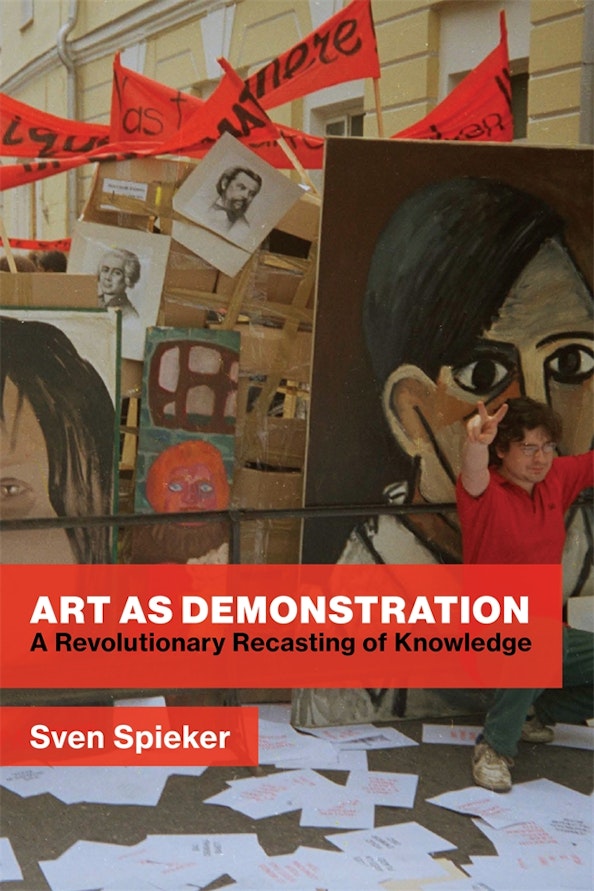
Upon its release, Sven Spieker’s new monograph, Art as Demonstration, found its place among publications related, in one way or another, to art and protest. This constitutes a significant portion of my book collection. Being a protest researcher myself, I not only love to replenish this shelf, but also make use of it quite regularly. The frequently handled covers, however, do not show signs of wear easily—their predominantly red and orange hues continue to convey a sense of warning. Art as Demonstration is no exception in visual terms. Its cover features a photograph of the Barricade (1998), a demonstration-performance by Extra-Governmental Control Commission, a short-lived artist group from the turn-of-the-century Moscow. Scarlet banners, reddish motifs in the paintings used as part of the barricade, and the red T-shirt worn by the group’s co-founder, Anatoly Osmolovsky, set the overall graphic tone.
Despite the design choices and the initial allusions suggested by its title, Art as Demonstration is not a book about protest art—at least not to the extent one might expect. “Briefly put, ‘to demonstrate’ is to show or point out,” Spieker writes in the introductory chapter. “And while to our modern ears the term is mostly associated with mass political protest, it has a long pedigree in a variety of other disciplines, ranging from philosophy to rhetoric and the sciences” (p. 5). He then discusses the term’s meanings in various spheres of human activity, from science and the legal sphere to rhetoric and production of knowledge. Thus, in the book, Spieker seeks to reassemble the various meanings of “demonstration” that have grown apart—demonstration as the didactic, demonstration as argument, demonstration as protest—“to give added traction to contemporary discussions of art as protest, activism, and resistance, assuming that a closer, more historical look at art’s connection with demonstration may help us reconnect with earlier efforts to marshal art for instructional purposes, […]” (p. 5).
Although not immediately obvious, the link between instruction, the didactic, and revolt is relatively close and has been time and again emphasized historically. An instance that comes to mind first is Paolo Freire, the Brazilian educator and father of critical pedagogy, and his Pedagogy of the Oppressed (1968), which inspired not only generations of educators, but also those oppressed, to confront their “fear of freedom.” Freire is not cited in Spieker’s study; yet the Zeitgeist of the 1960s, marked by both protest and (counter)educational fever, is the book’s starting point and important fulcrum throughout. It is from this context that the book’s subtitle emerges. As Spieker claims, the long 1960s, both in the West and the East, were characterized not only by a determined rejection of the old educational system, associated with unequal production and distribution of knowledge, but, simultaneously, by a striving toward a new educational project conceived as a revolutionary recasting of knowledge.
As someone who has intermittently written and edited also on education in, through, and for art, I appreciate Spieker’s extension of the “pedagogical/educational turn” well before the 2000s. He not only demonstrates the variety of art practices engaged with education from as early as the 1960s, but more importantly digs out its theoretical starting point, an essay by Barbara Rose “The Value of Didactic Art” (Artforum, April 1967). Interestingly enough, Rose herself theorized not only the practice of her contemporaries, like Andy Warhol or Jasper Johns, but also saw the perfect embodiment of her concept of didactic art in much earlier examples, namely Marcel Duchamp’s readymades. Unlike artists who, tempted by the widely disseminated educational fever characteristic of the first quarter of the current century, eagerly embrace (some say, appropriate) educational forms in their art practices or merge their pedagogical and artistic activities into one, Rose (as well as Spieker) links her notion of didacticism less to educational formats (like class, lesson, school, etc.) and to the content of teaching, than to the very way a certain concept or argument is demonstrated in front of the viewers’ eyes. Although despite Duchamp’s non-assisted readymades may have nothing in common with educational formats as we know them, yet in this approach, they may be perceived as demonstrational because their very existence exemplifies the idea that art can be defined by purely institutional criteria beyond aesthetic judgment and taste.
The paradox, which I find particularly interesting, is purely linguistic: detested by modernism due to its heteronomous status, “didactic art” re-entered the 1960–70s art critical vocabulary, yet it was soon discarded and eventually replaced by “the educational,” and, less preferably, by “the pedagogical.” Apparently, the secondary meaning of the term didacticism, which signifies moral instruction or even patronizing (the hierarchical model of conveying knowledge the educational revolutionaries of the 1960s sought to recast), has almost entirely supplanted its primary meaning, a simple “teaching” (ancient Greek didáskō, “I teach, educate”). Whereas “education” and “pedagogy”, which initially meant “leading (a child)” (with roots respectively in Latin and ancient Greek) and thus clearly implied hierarchical structure, have gradually taken on a more neutral meaning—especially “education,” which encompasses both teaching and learning.
Sven Spieker. „Art as Demonstration. A Revolutionary Recasting of Knowledge.” MIT Press, 2024. 352 p., illustr.
The book contains ten chapters, all of which, except for an introductory overview of the theme and a very brief postscript, consist of lengthy and detailed analyses of particular artistic practices. Spieker does not aim to create a typology of art as demonstration (and his refusal to write an actual concluding chapter reinforces this impulse toward anti-systematization). Instead, he chooses to look at certain artists in their very concrete sociopolitical situations and examine what their approaches to instructing, lecturing, didacticism, showing, or protesting can tell about various meanings and uses of demonstration, which do not necessarily correspond to dictionary definitions. Spieker’s selections are not always the most obvious. For instance, Joseph Beuys, widely known both for his politically-laden artworks, as well as deep engagement with education, although referenced intermittently throughout the book, is not among its protagonists. Nor is Andrea Fraser, whose lecture performances, through their over-identified personae, physically demonstrate the discrepancies between art-institutional discourses and their intended meaning. Nevertheless, most of the book’s main figures are equally prominent, including Bernar Venet, Daniel Buren, Robert Morris, Harun Farocki, Milan Knížák, Clemens von Wedemeyer, and Ilya Kabakov. Surprisingly, considering Spieker’s claim that demonstration and didacticism were central to many feminist artists’ positions (p. 32), there are only two individual women artists among them, Adrian Piper and Ulrike Meinhof, with others, such as Martha Rosler, Sanja Iveković or Ewa Partum, appearing only in cameo roles outside the chapter titles.
The range of practices Spieker analyzes is, however, impressively broad. These include such educational formats as lectures (or lecture performances) and seminars by Venet and the scientists he commissioned, Kabakov, Morris, and posthumous “Walter Benjamin” (whose identity Spieker deliberately does not disclose, accepting rules of the game as a crucial part of the semiotic whole of the performance; however an inquisitive reader may satisfy their curiosity online). Other educational efforts include institutional initiatives such as Bazon Brock’s Visitors’ School at documenta from 1968 to 1992; diagrammatic drawings and graphic instructions by Venet, Mladen Miljanović, and Ciprian Homorodean; and short and feature films by Farocki, Paweł Kwiek, Meinhof, Wedemeyer, and Sylvain George. Individual and group street performances and happenings by Buren, Beuys, Knížák, and Jiří Kowanda; as well as private performances or performances for the camera by Iveković, Rosler, Piper, or the Collective Actions group. Street demonstrations by Extra-Governmental Control Commission, Radek Community, Chto Delat; other formats and artists occupy positions between these categories.
Equally striking is the thoroughness of Spieker’s analyses. Not only does he interpret the content of artworks with semiotic precision to show how they may be considered demonstrations and what they attempt to demonstrate—be it a specific scientific idea, a political message, a doubt concerning art historical truths, or questioning of the reality in which the artists lived—but also how, by conveying their message these artworks interrogate the very concept of (scientific, instructional, political) demonstration and its historically accepted forms. In most cases, Spieker also provides a detailed account of the sociopolitical context in which the artworks were created; development of the projects, often accompanied by insights from the artists themselves or their fellow artists, project participants, or producers; and occasionally even on the reception by the audiences or institutions. Thus, his research sources include, among other archival materials, artist writings, interviews, and egodocuments. These sources allow him to trace not only the undertaking of a project and its eventual development, but the artist’s initial conception, their evolving attitude over time, and occasionally, their disappointment or arrival to the understanding that the chosen means do not achieve the intended effect.
One of my favorite chapters is chapter 6, which focuses on Ulrike Meinhof’s TV film Bambule: Juvenile Reform—for Whom?, co-directed by Ebenhard Itzenplitz (produced between 1968 and 1970, but first aired only in 1994). The film narrates a story of an actual reform school for adolescent girls, who had dropped out of the standard school system. The chapter initially introduces the project by discussing the German concept of Bildung (education), in both philosophical thought and educational practice, thereby providing the reader with crucial socio-political context. Subsequently, while recounting and analyzing the film’s narrative, Spieker simultaneously examines Meinhof’s intentions, initial concept, and vision—for example, her desire to cast actual reform school students instead of professional actors—her disagreements with Itzenplitz regarding the script and directing choices, and, most importantly, her growing disappointment with the film’s effectiveness for the agitational purpose she initially set for it: that the film might serve as an emancipatory tool, potentially liberating the girls from their prison-like educational institution and their otherwise precarious lives. The chapter, thus, is significant not only because it highlights Meinhof—widely known as a terrorist in the Red Army Faction, a West German far-left militant group, and far less recognized as an artist—but also because it provides a detailed examination of an artist’s uncertainties and eventual disillusionment regarding art’s stake in societal change, which may have contributed to Meinhof’s eventual radicalization.
Although the chapters are interesting and captivating in themselves, taken together they may leave some readers questioning whether the artworks discussed have enough in common to form a coherent argument or to belong in a single volume. This impression, in my view, steams partly due to the absence of a unified theoretical framework for these analyses—which is, however, frequently mitigated by the discussion of theoretical context or inspirations for a particular art project, as exemplified in the chapter on Meinhof—and partly from the rather uneven “typology” structuring the chapters. Some chapters group different artworks based on their pursuit of entirely new potential for art (e.g. “2. Ostentatious Neutrality” or “6. Learning From the Situation”), others according to medium or an approach to a medium (e.g. “3. Burlesque Lecture Demonstration” “4. Film as Operation”), and yet others according to a more traditional, time- and space-constrained historical model (e.g. “5. Taking it to the Street: Eastern European Art Demonstrations” or “9. Demonstration in Soviet and Post-Soviet Space”).
It seems to me that the overall narrative would have been more integrated and compelling if the book was restructured to show how similar demonstrational strategies in art can lead to very different outcomes. Thus, Venet’s painted diagrams accompanied by scientific lectures (chap. 2), which represent his critique of formal innovation in art as its aesthetic value and his aspiration to fully concentrate on the information art conveys (or its monosemic properties), may be considered alongside Morris lecture performance 21.3 from 1964 (chap. 3). Morris’s lecture, which consisted of a recorded reading of Erwin Panofsky’s classical writings on iconology, as well as live embodiment of the reading, ultimately creates both a temporal and conceptual gap between what is said and what is shown by the body (or polysemy)—thus producing an effect entirely opposite to that sought by Venet. Farocki’s agitational flyer films from the 1960s (chap. 4) appear to share their mood with Homorodean’s graphic instructions from 2010 on how to survive capitalism (chap. 5). If Farocki, very much in Freire’s spirit, aimed to clearly distinguish the oppressed from their oppressors and to encourage viewers’ active engagement in their situation, then various theft strategies depicted by Homorodean replace revolutionary idealism with an emphasis on individual survival, and the belief in art’s educational potential with a parody of didactics. Brock’s ambition to educate documenta’s audience in his Visitors’ School (chap. 7) finds its counterpart in Kabakov demonstrating and explaining his artworks to his studio visitors, as documented in numerous photographs and analyzed by Spieker in chapter 8. On opposite sides of the Iron Curtain, both figures shared the belief that artworks do not necessarily speak for themselves; whereas in Kabakov’s case, it was the artist who demonstrated the artwork’s argument, and in the Visitors’ School, this role was transferred to a mediator. Restructuring chapters to avoid geopolitical typology of East and West would have also strengthened, in my view, Spieker’s claim that “a more comprehensively oriented take on the era has now emerged that not only includes the nations of the former Eastern Bloc but is also mindful of the many ways the two sides remained connected, defying the Cold War’s binary logic” (p. 5).
Art as Demonstration is nevertheless a very worthwhile read for those interested in the roots of the ongoing pedagogical fever within art institutions or in contemporary art’s revolutionary aspirations and failures, as well as for those researching both art (as) education and protest (as) art and wondering how these two interests may be combined. As someone who identifies with post-Soviet Eastern Europe1 and still frequently encounters the fact that Western research on the Eastern Bloc’s art is almost exclusively focused on art in socialist states (most often Poland, Czechoslovakia, and Yugoslavia) beyond the USSR, I appreciate Spieker’s effort to expand the scope by including examples from the (former) Soviet space (in fact, Russia). This leads me to believe that the post-Soviet Europe still has much to offer for future research into art’s role in countering official narratives, hopefully including beyond Moscow art circles.
- Bearing in mind that Eastern Europe is a historically unstable and ambiguous term: Spieker’s demarcation of Eastern Europe in this book coincides with the former Eastern Bloc outside the Soviet Union, whereas some definitions would include the European part of the USSR under Eastern Europe, and the former socialist states as part of Central and Southeast Europe. The Baltic States, the region where I am from, often occupy an intermediate position, both historically and, at times, mentally, identifying as Eastern Europe, while aspiring to, and often also being classified as, Northern Europe. ↩︎
Lina Michelkevičė
Lina Michelkevičė jest adiunktką w Instytucie Badań nad Sztuką Akademii Sztuk Pięknych w Wilnie, wykładowczynią oraz autorką książek Tarytum ruošėmės tikram veiksmui. Kultūros kūrėjai ir protestas [Jakbyśmy nieustannie przygotowywali się do prawdziwego działania. Twórcy kultury i protest] (2025) oraz Būti dalimi. Dalyvavimas ir bendradarbiavimas Lietuvos šiuolaikiniame mene [Być częścią. Uczestnictwo i współpraca w litewskiej sztuce współczesnej] (2021). Jej zainteresowania badawcze obejmują partycypację kulturową i społeczną, politykę przestrzeni publicznej, aktywizm, performatywność, narzędzia pedagogiczne w sztuce oraz interdyscyplinarne formy sztuki, edukacji i badań.


